
Q235 vs Q345 (Now Officially Q355) Steel
June 15, 2026
Hot-Dip Galvanized vs Powder-Coated Guardrail: Which Should You Choose?
July 28, 2026
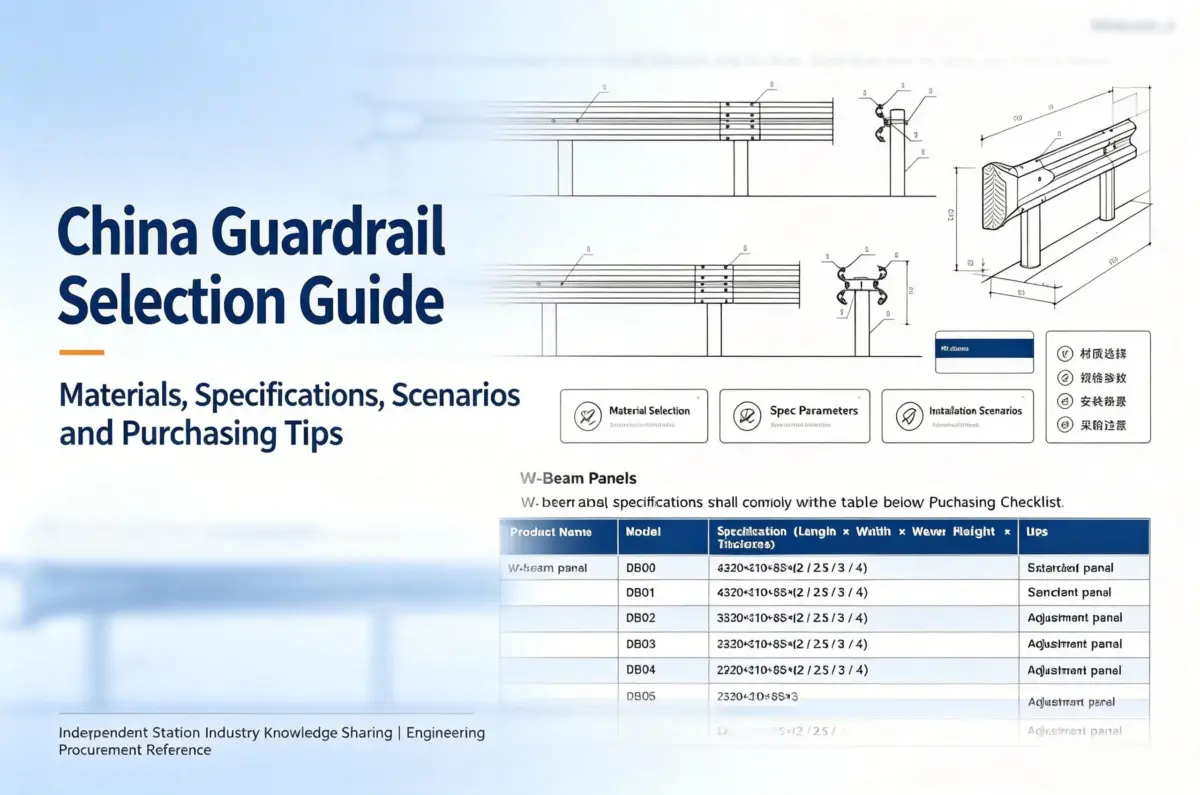
In 2017, China officially renamed the guardrail “containment level” to “protection level”—shifting its mission from “stopping the vehicle” to “protecting the people inside.” That shift ultimately comes down to a few millimeters of steel plate thickness. This article walks you from protection levels all the way to the exact specifications of W-beam and Thrie-beam guardrail panels.
1. A Guardrail Is More Than a Strip of Steel: Three Structural Types
The essential function of a guardrail is to absorb impact energy, redirect a vehicle, and prevent it from running off the road or crossing into oncoming traffic when the vehicle leaves the carriageway out of control. Whether—and how—it achieves this depends on the guardrail's structural type.
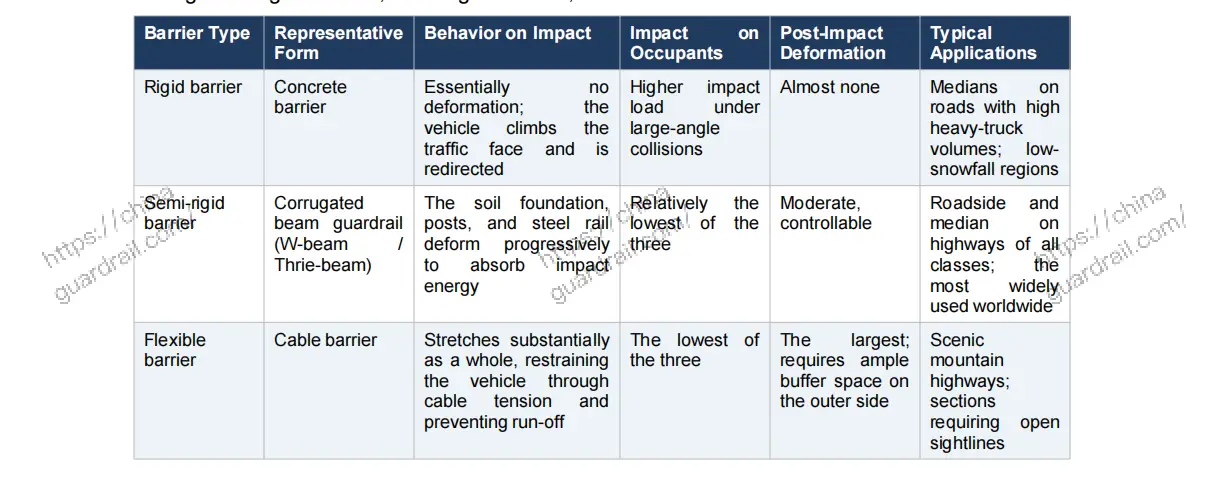
Classified by the degree of deformation after impact, highway guardrails fall into three categories: rigid barriers, semi-rigid barriers, and flexible barriers.
Each type has its own range of suitable use. This article focuses on the category with thelargest global export volume—the semi-rigid corrugated beam guardrail.
2. Why Semi-Rigid Corrugated Beam Guardrails Dominate theGlobal Export Market
The core competitiveness of corrugated beam guardrails lies in their energy-absorbing structure.At the instant of impact, the force is first transmitted to the corrugated steel rail, which bends and deforms; then to the posts, which tilt or bend within the soil foundation; and finally to the soil foundation itself, which absorbs the remaining energy. This three-stage deformation sheds force layer by layer, dispersing an impact that would otherwise strike the human body directly across an interval of time and distance.This mechanism delivers several advantages that matter greatly in real-world engineering:
Lower harm to occupants. Semi-rigid barriers cause relatively less harm to vehicles and occupants, avoiding the severe instantaneous shock that rigid barriers impose under large-angle collisions.
Repairable after impact, low maintenance cost. Beam panels and posts are standardized components; after a collision, only the damaged section needs replacing—no full reconstruction required. This is especially valuable for highway maintenance in developing countries.
Lightweight and economical to ship. Taking a standard W-beam panel as an example, a 4-meter panel at 3mm thickness weighs about 48kg, and about 66kg at 4mm thickness—far less than a concrete barrier of equivalent protective length. Container loading and on-site installation are both more cost-effective.
Flexible specifications, full protection-level coverage. By adjusting plate thickness, wave profile (W-beam / Thrie-beam), post section, and spacing, corrugated beam guardrails can cover the full protection-level range from Level 2 to Level 6, suiting every scenario from county roads to expressways.
Broad standards recognition. Corrugated beam guardrails are a form recognized jointly by major standards including China's GB/T 31439, Europe's EN 1317, the United States' AASHTO/MASH, and Australia's AS/NZS. EN 1317 test reports issued by Chinese factories are widely accepted in project tenders across Africa, Southeast Asia, and the Middle East.
3. Guardrail Panel Product Specifications by Protection Level
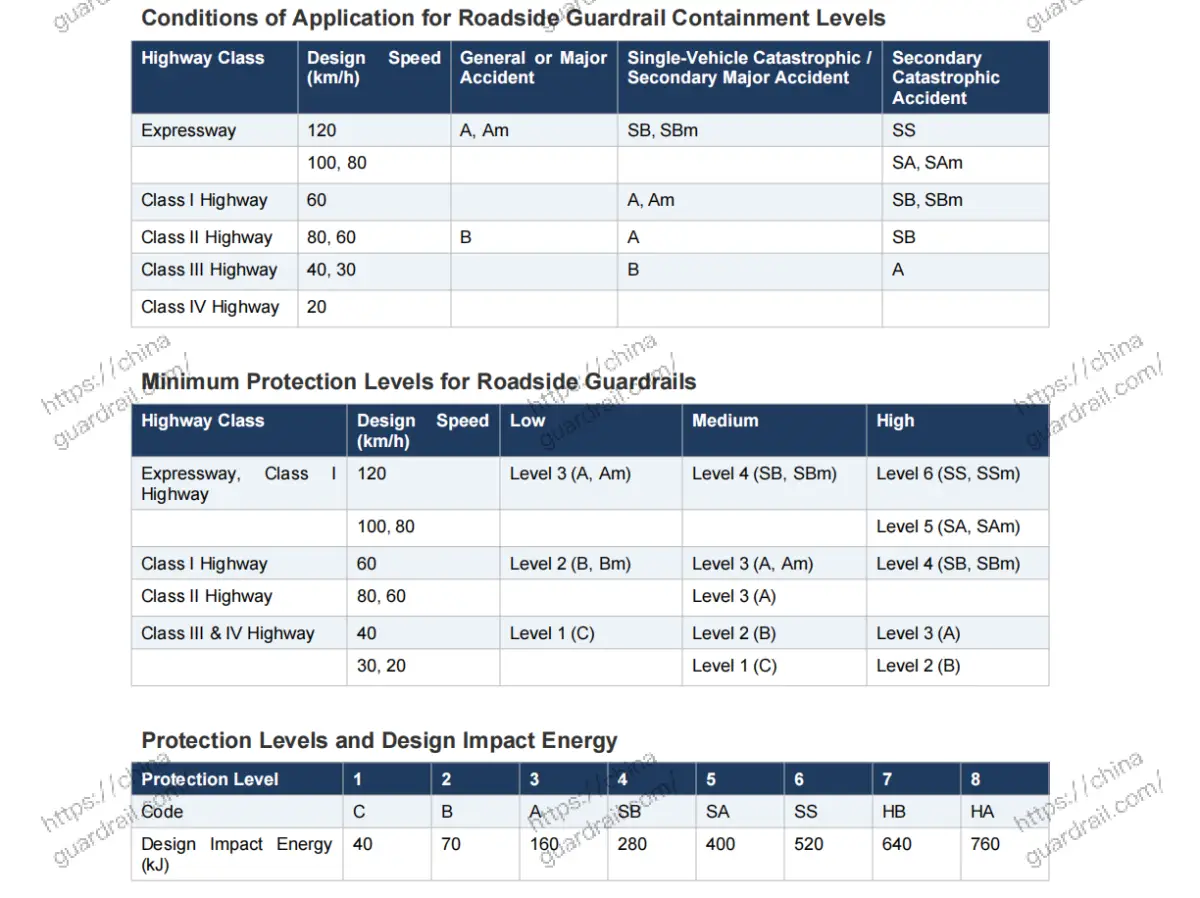
China's latest revision officially renamed the “containment level” to “protection level,” shifting the core philosophy from “how large an impact the guardrail can withstand” to “how well the guardrail can protect drivers and passengers.” This shift is reflected directly in the panel specifications required at each level.
Current standards classify roadside guardrail protection into six levels. For corrugated beam guardrails, different protection levels correspond to entirely different panel models, thicknesses, post sections, and installation spacings. The product specifications for each level are set out below.
3.1 Roadside Guardrail Containment Level Reference Tables
Conditions of Application for Roadside Guardrail Containment Levels
3.2 Design Specifications for Chinese Corrugated Beam Panels: W-Beam and Thrie-Beam
W-beam
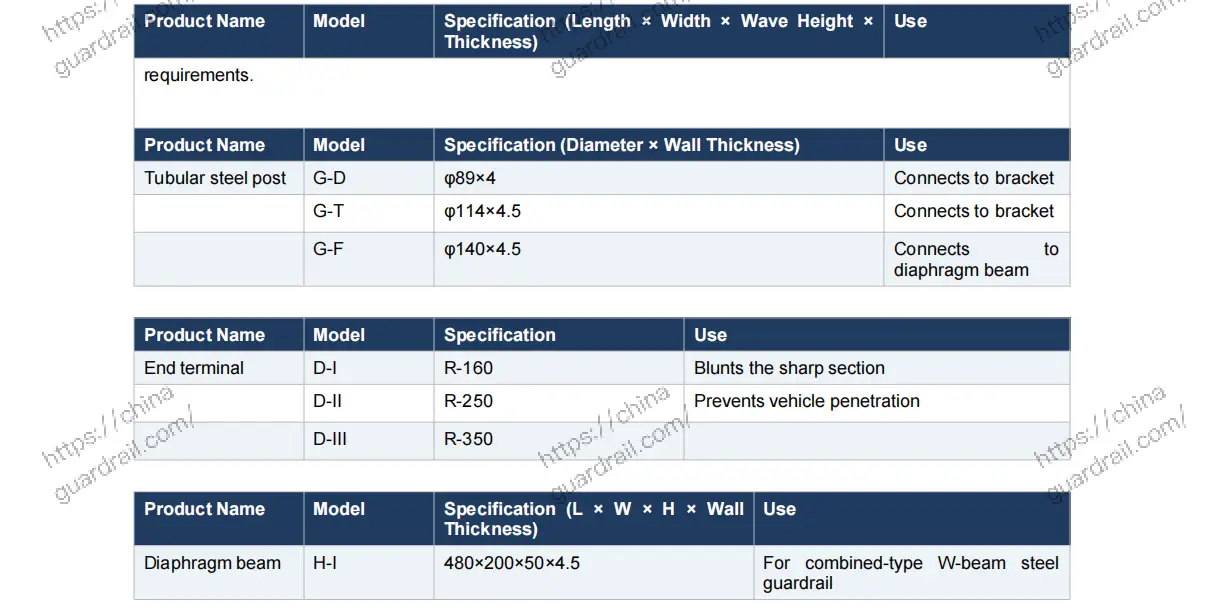
A W-beam steel guardrail is composed of W-beam panels, tubular steel posts, end terminals, splice bolt assemblies, connecting bolt assemblies, and brackets or diaphragm beams.
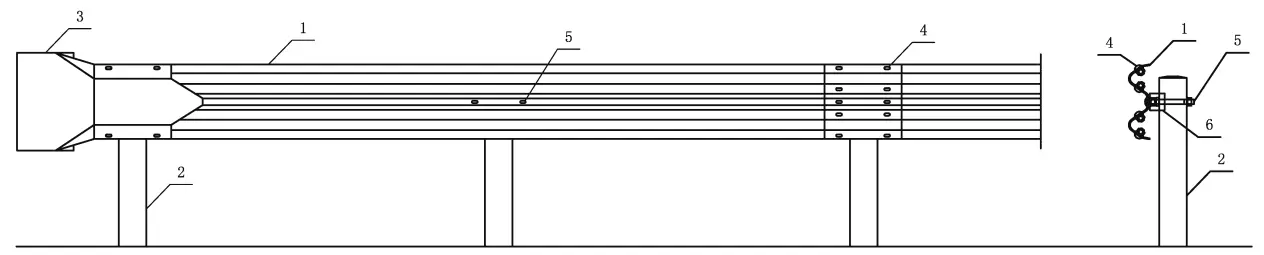

Components: 1—W-beam panel; 2—tubular steel post; 3—end terminal; 4—splice bolt assembly; 5—connecting bolt assembly; 6—bracket; 7—diaphragm beam.
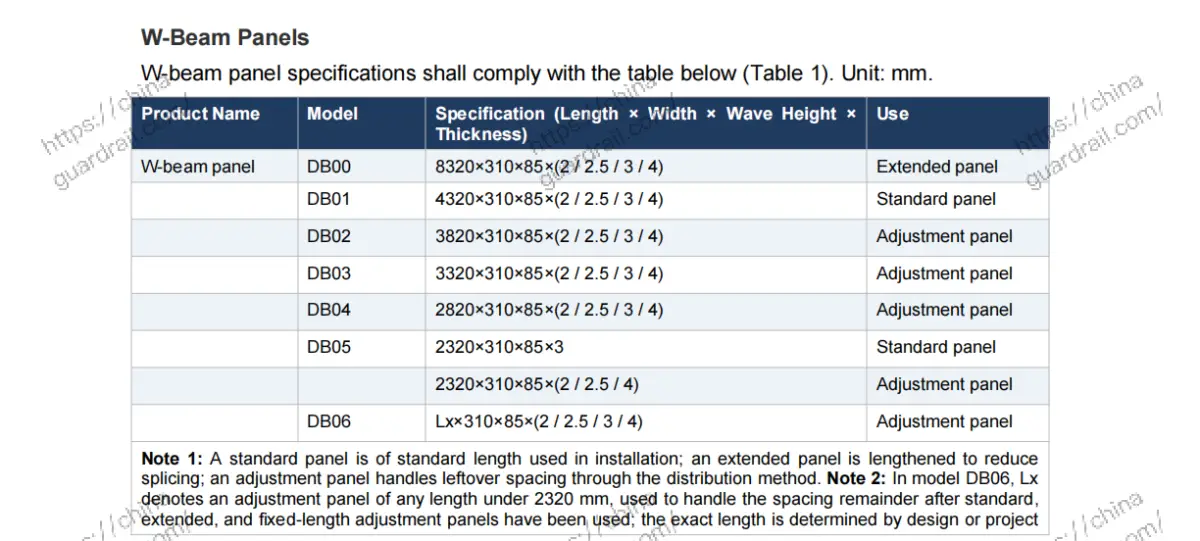
W-Beam Panels
Thrie-beam
Thrie-beam steel guardrail is composed of Thrie-beam panels, Thrie-beam backup plates, transition rails, posts, blockouts or brackets, end terminals, splice bolt assemblies, connecting bolt assemblies, and reinforcing rails
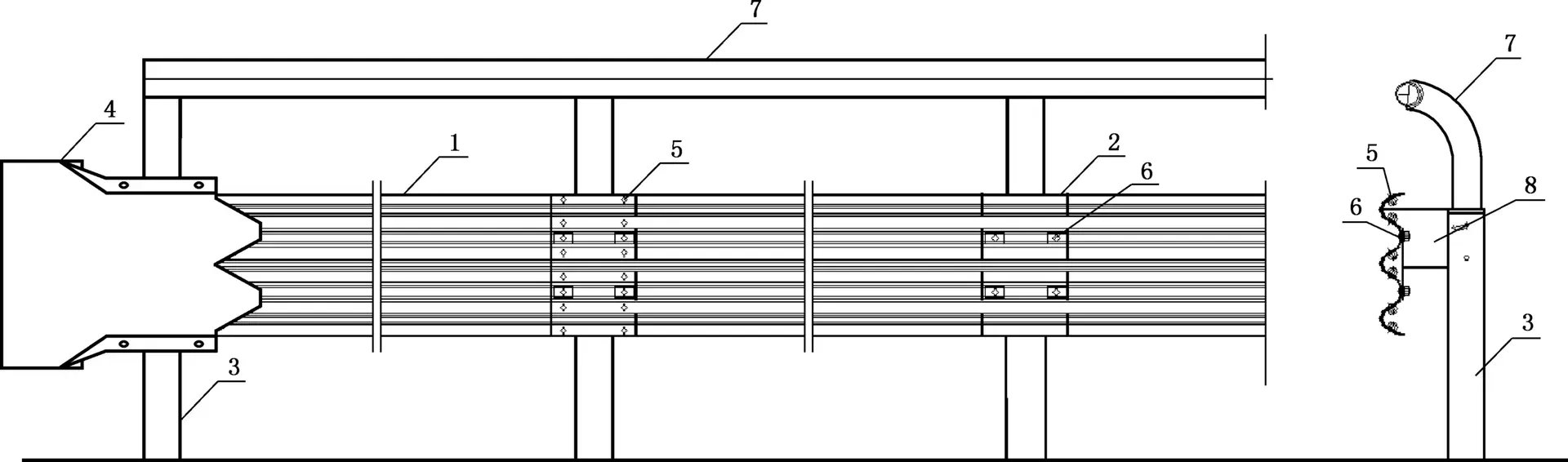
Components: 1—Thrie-beam panel; 2—Thrie-beam backup plate (used only with H-section steel posts); 3—post; 4—end terminal; 5—splice bolt assembly; 6—connecting bolt assembly; 7—reinforcing rail; 8—blockout or bracket.
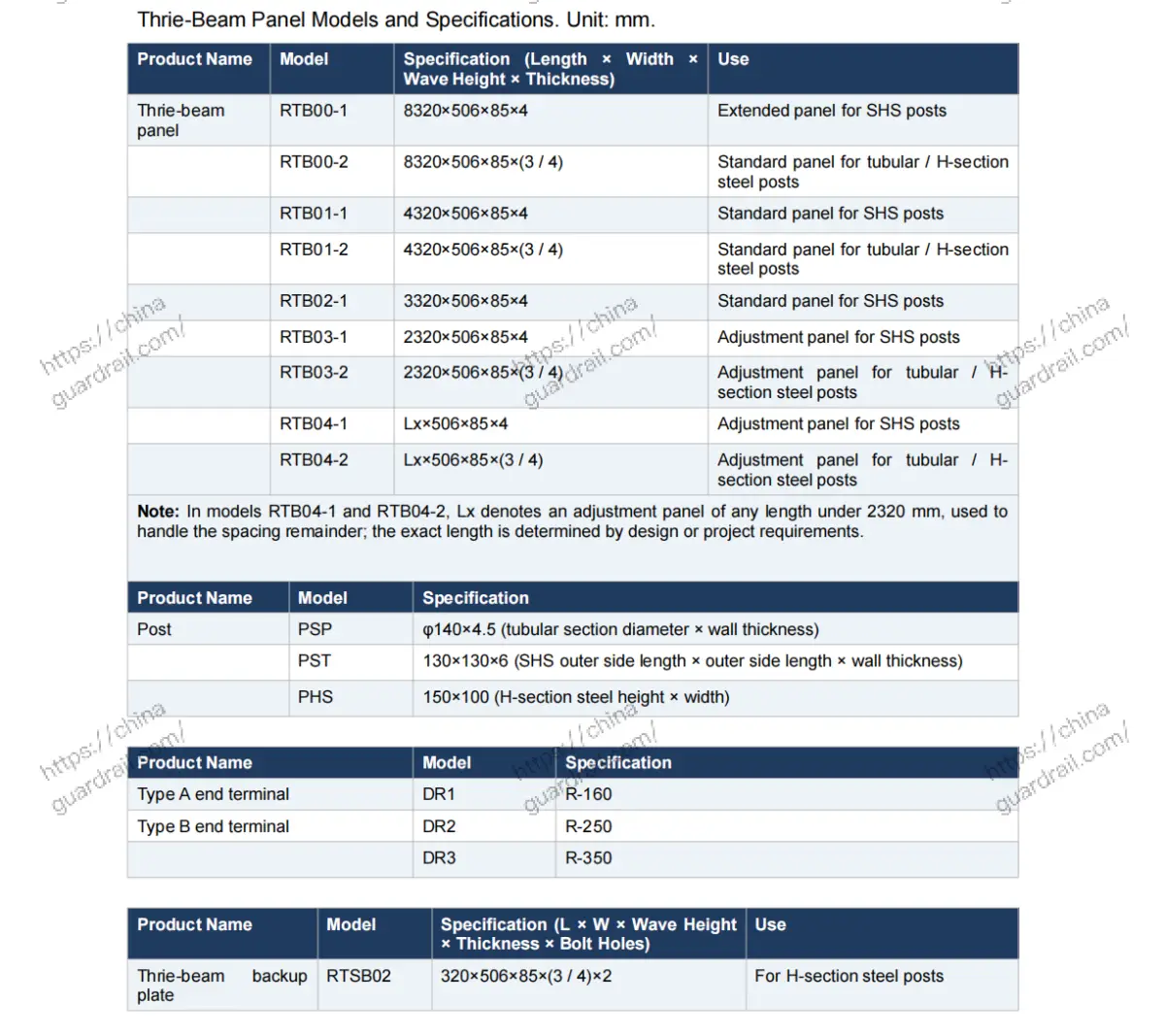
Thrie-Beam Panels
Thrie-Beam Panel Models and Specifications. Unit: mm.
3.3 Guardrail Model Selection Reference Table
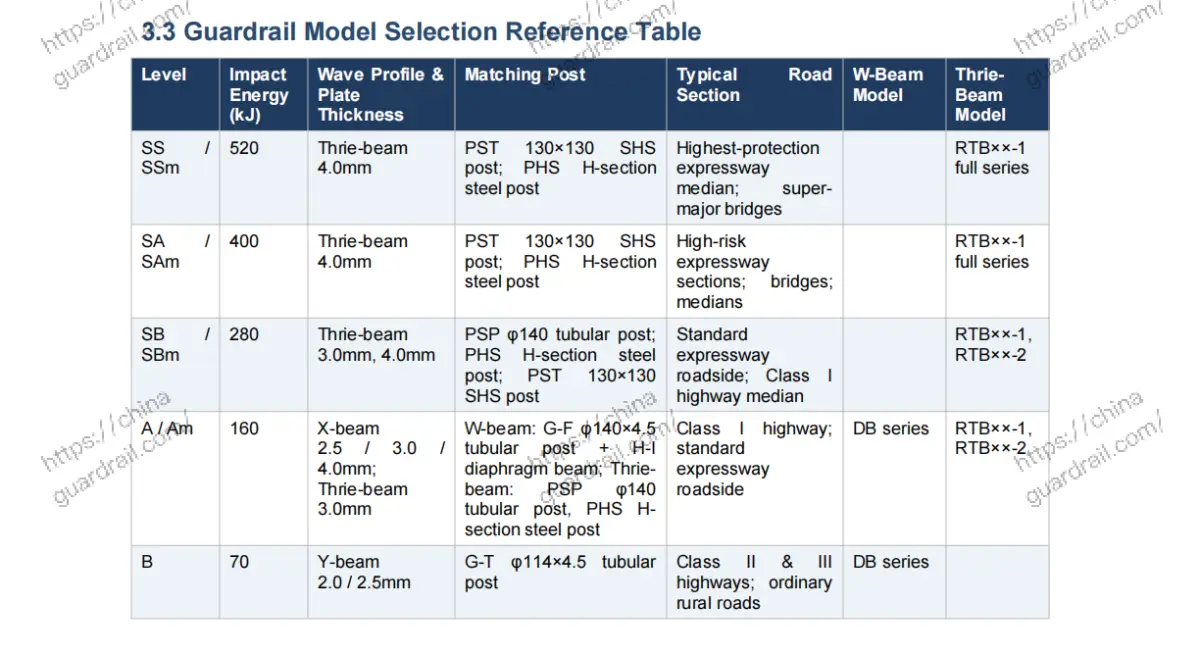
Three rules for reading this table:1. Levels B (Level 2) and A (Level 3) can use W-beam panels; from Level SB (Level 4) onward, everything switches to Thrie-beam panels. W-beam is the mainstay for low-to-medium protection levels, while Thrie-beam specializes in high protection levels.2. Plate thickness increases with level. Level B uses 2.0mm; Level A introduces the 4.0mm option; by Levels SA and SS, 4.0mm becomes uniform. The thicker the plate, the greater the energy-absorption capacity per panel.3. Posts upgrade with level. Lower levels use φ114 and φ140 tubular posts; higher levels (SA, SS) switch to 130×130 SHS posts or H-section steel posts, relying on stronger posts and higher system stiffness to withstand high-energy impacts.
The models above follow GB/T 31439.1—2025. The post spacing, embedment depth, and blockout configuration for a specific project must still be determined in conjunction with the project design documents.
4. Pre-Inquiry Specification Checklist
Once you understand the protection levels and their corresponding specifications, you can avoid most communication errors when requesting a quote from a Chinese supplier. We recommend providing the following information with your inquiry:•
Highway class (expressway / Class I / Class II / Class III & IV)•
Design speed (km/h)•
Road section type (roadside section / bridge section / median)•
Roadside clear zone conditions (whether there are hazardous obstacles such as railways, water bodies, steep slopes, or bridge piers within the calculated clear zone width)•
Installation position (roadside type B / A / SB, or median type Bm / Am / SBm)•
Applicable local standards (whether EN 1317, AASHTO / MASH, or a national standard is required)•
Corrosion protection requirements (hot-dip galvanizing coating weight; whether powder coating or spray coating is needed)
By providing these seven items in one go, your supplier can accurately match the protection level, panel model, plate thickness, post specification, and accessory list—making quotes truly comparable and avoiding procurement risks caused by unclear specifications.
Data sources: GB/T 31439.1—2025; JTG D81—2017; DB32/T 4512—2023. This article is an industry knowledge share; actual engineering design shall be governed by current standards and project documents.


1 Comment
[…] to H1–H2, produced to AASHTO M180 beam dimensions and GB/T 31439 material requirements. See our EN 1317 containment levels guide for the full […]