Hot-Dip Galvanized vs Powder-Coated Guardrail: Which Should You Choose?
July 28, 2026
Highway Guardrail Installation Conditions: Clear Zone, Roadside Risk and Protection Levels
August 9, 2026
1. What Is a Guardrail Crash-Protection Level?
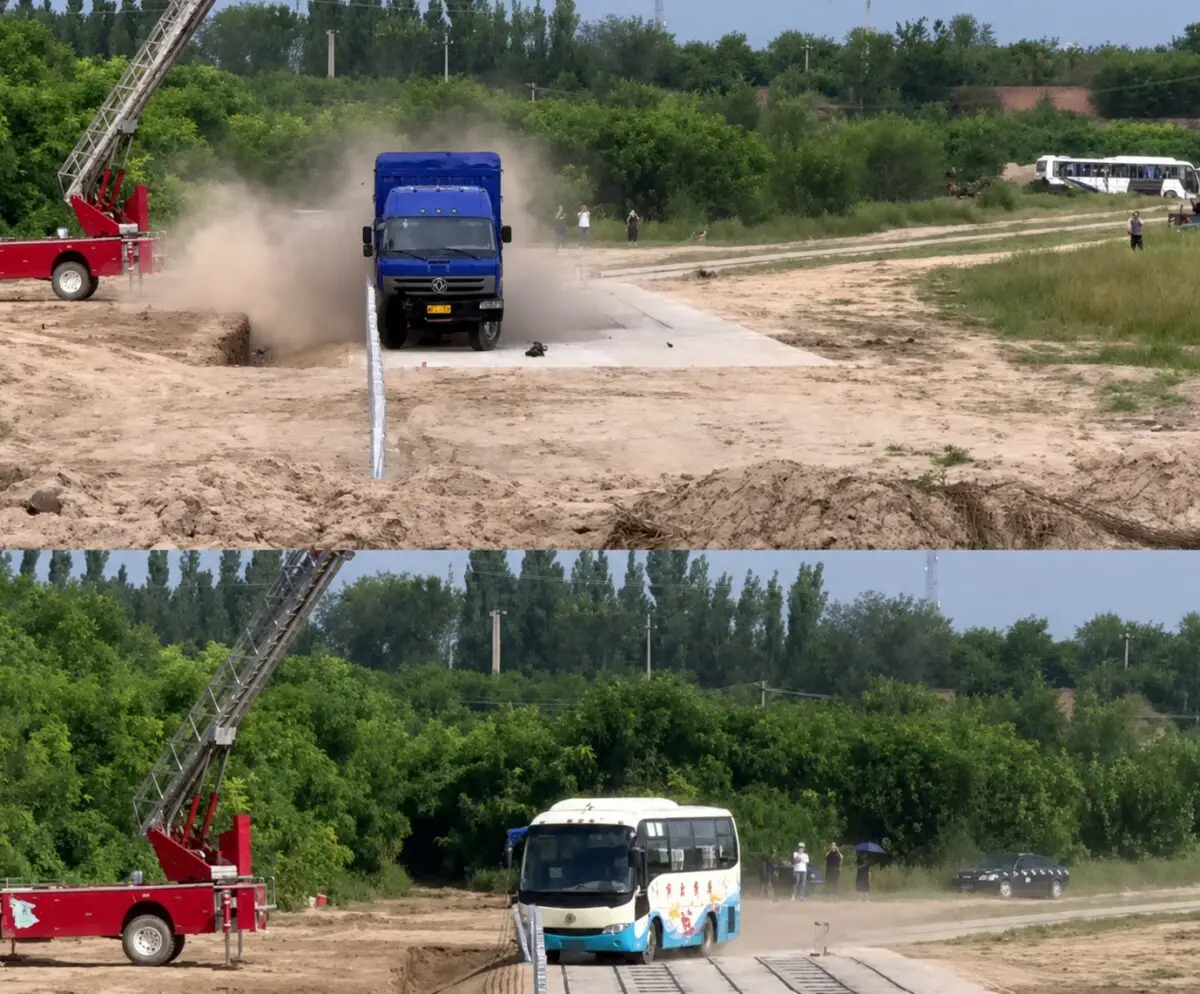
A crash-protection level describes the ability of a complete guardrail system to withstand vehicle impact under specified test conditions while maintaining its containment, energy-absorption and vehicle-redirection functions.
A crash-protection level is not the thickness of a guardrail beam, the strength of the steel, or the product name of a single W-beam panel.
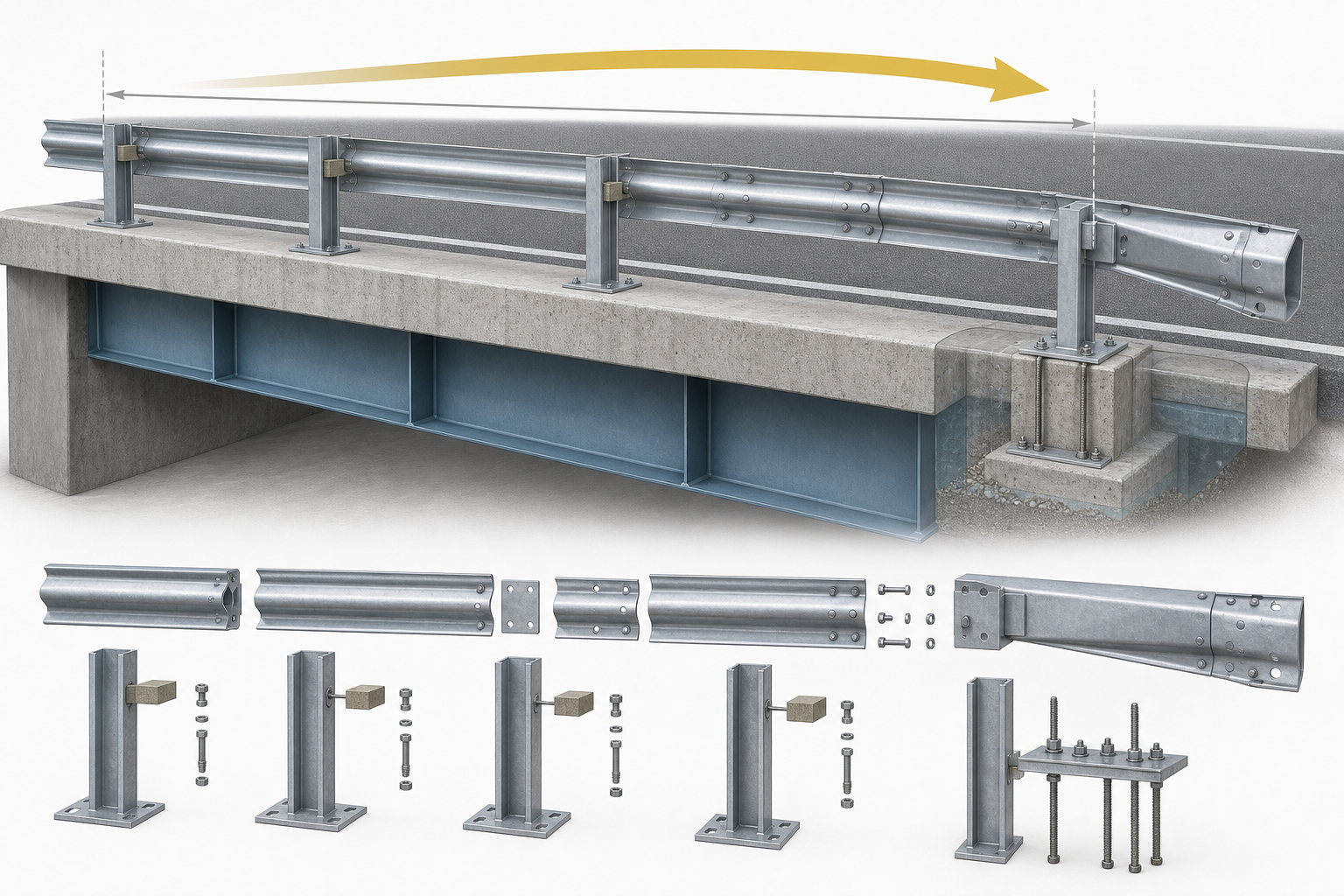
A complete guardrail system normally includes:
- guardrail beams;
- posts;
- spacers or blockouts;
- bolts and splice components;
- terminals;
- transitions;
- bridge connection components; and
- the foundation and installation conditions.
Changing any of these components can change the tested crash performance.
2. Crash-Protection Level Comparison
2.1 China: JTG B05-01—2013
| Level | Reference impact energy |
|---|---|
| C | 40 kJ |
| B | 70 kJ |
| A | 160 kJ |
| SB | 280 kJ |
| SA | 400 kJ |
| SS | 520 kJ |
| HB | 640 kJ |
| HA | 760 kJ |
Source: the official JTG B05-01 document issued by China’s Ministry of Transport. Official source
2.2 United States: MASH (MASH crash-testing requirements)
| MASH test level | Reference impact energy |
|---|---|
| TL-1 | approximately 39 kJ |
| TL-2 | approximately 77 kJ |
| TL-3 | approximately 156 kJ |
| TL-4 | approximately 209 kJ |
| TL-5 | approximately 596 kJ |
| TL-6 | approximately 596 kJ |
These are calculated reference values based on representative test conditions. They are not official MASH level-conversion values. TL-5 and TL-6 have similar reference energy, but use different test vehicles. Original AASHTO MASH source
2.3 Europe: EN 1317 (EN 1317 series)-2
| Level | Representative test | Reference impact energy |
|---|---|---|
| N1 | TB31 | approximately 43 kJ |
| N2 | TB32 | approximately 82 kJ |
| H1 | TB42 | approximately 127 kJ |
| H2 | TB51 | approximately 287 kJ |
| H3 | TB61 | approximately 462 kJ |
| H4a | TB71 | approximately 572 kJ |
| H4b | TB81 | approximately 725 kJ |
These values are calculated reference values based on the EN 1317 test vehicle, speed and angle. They are not a direct conversion formula between levels. Official EN 1317-2 page
2.4 Japan: Vehicle Safety Fence Standard
| Level | Official impact energy |
|---|---|
| C | 45 kJ |
| B | 60 kJ |
| A | 130 kJ |
| SC | 160 kJ |
| SB | 280 kJ |
| SA | 420 kJ |
| SS | 650 kJ |
Source: Japan’s official Vehicle Safety Fence Standard issued by the Ministry of Land, Infrastructure, Transport and Tourism. Official Japanese source
2.5 Unified Reference Comparison
| Approximate energy band | China | United States | Europe | Japan |
|---|---|---|---|---|
| 40–45 kJ | C: 40 | TL-1: approx. 39 | N1: approx. 43 | C: 45 |
| 60–82 kJ | B: 70 | TL-2: approx. 77 | N2: approx. 82 | B: 60 |
| 127–160 kJ | A: 160 | TL-3: approx. 156 | H1: approx. 127 | A: 130; SC: 160 |
| 209–287 kJ | SB: 280 | TL-4: approx. 209 | H2: approx. 287 | SB: 280 |
| 400–462 kJ | SA: 400 | — | H3: approx. 462 | SA: 420 |
| 520–650 kJ | SS: 520 | TL-5/TL-6: approx. 596 | H4a: approx. 572 | SS: 650 |
| 640–760 kJ | HB: 640; HA: 760 | — | H4b: approx. 725 | — |
The table is for technical orientation only. It does not convert one country’s certification level into another country’s certification level.
3. What Are Crash-Test Conditions?
Crash-test conditions are the vehicle, speed, angle and installation requirements specified by a standard for evaluating a guardrail system.
They can include:
- test vehicle type;
- vehicle mass;
- impact speed;
- impact angle;
- impact-point location;
- tested guardrail length;
- foundation and soil conditions;
- the vehicle’s post-impact path; and
- guardrail deflection and vehicle intrusion.
A level name without the test vehicle, speed and angle does not prove that a guardrail has achieved that level.
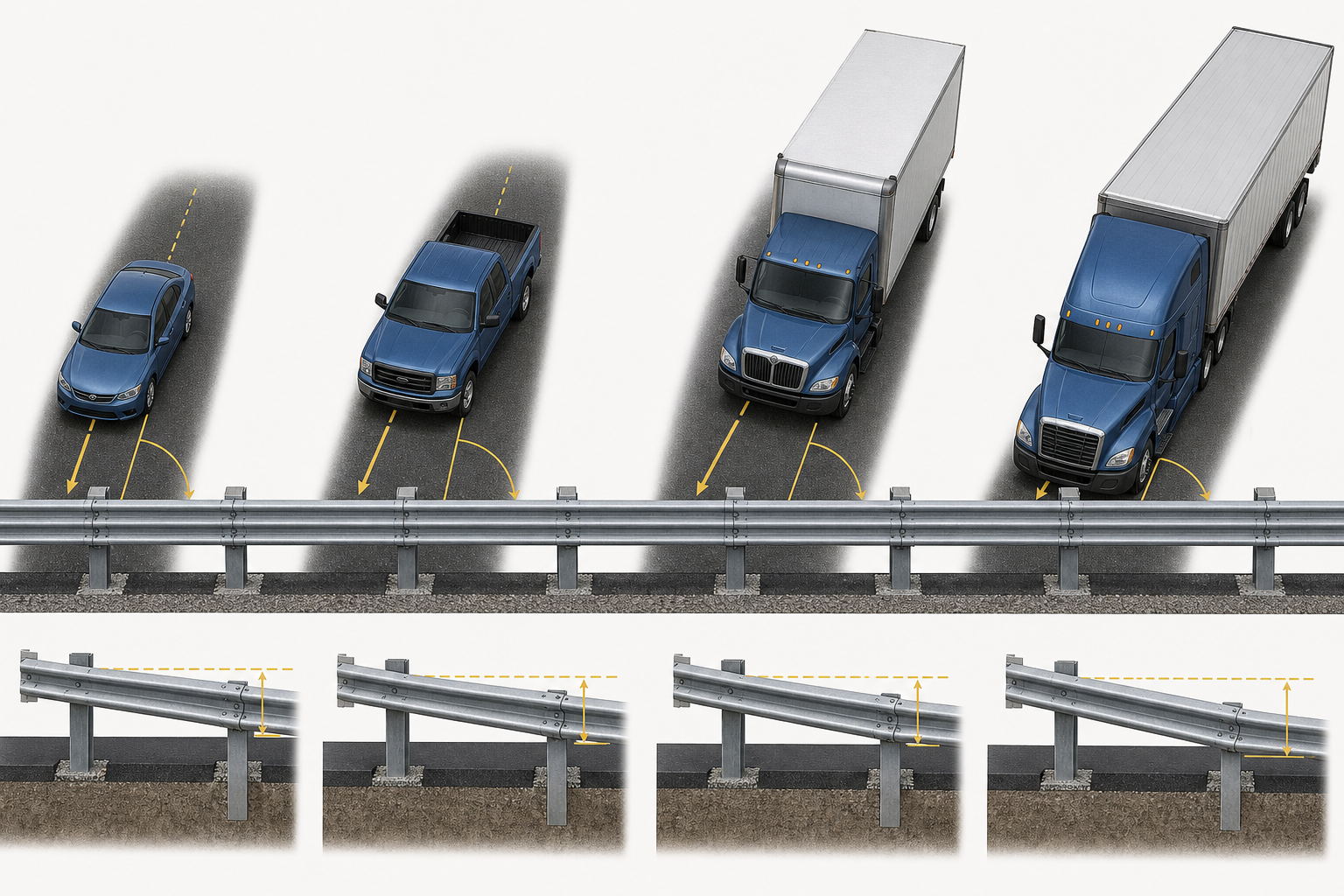
4. Crash-Test Conditions: China, the United States, Europe and Japan
4.1 China: JTG B05-01
China’s standard evaluates different safety functions with different vehicle categories:
- small vehicles are mainly used to evaluate cushioning performance;
- medium and heavy vehicles are mainly used to evaluate containment performance;
- both small and medium-to-heavy vehicles are used to evaluate redirection performance; and
- vehicle rollover, dynamic guardrail deflection and vehicle dynamic roll angle are also checked.
The tested guardrail must match the design drawings. The foundation, soil compaction, bridge deck edge and connection details must also match the design requirements.
The formal level-test conditions are defined in Table 5.3.3 of JTG B05-01. The table specifies test conditions for small passenger cars, medium-to-large buses and medium-to-large trucks by protection level. The explanatory text in Table 5-1 also provides project examples; the energy values below are the values listed for those examples:
| Guardrail example | Test vehicle | Mass | Speed | Angle | Listed impact energy |
|---|---|---|---|---|---|
| New bracket-type W-beam steel guardrail | Medium truck | 10 t | 60 km/h | 20° | 160 kJ |
| W-beam steel guardrail | Medium truck | 10 t | 60 km/h | 20° | 160 kJ |
| Double W-beam guardrail in a median | Medium bus | 10 t | 60 km/h | 20° | 160 kJ |
| Post-and-beam steel guardrail on the Hong Kong–Zhuhai–Macao Bridge | Large bus | 18 t | 80 km/h | 20° | 520 kJ |
| Reinforced crash-protection combination guardrail | Heavy truck | 33 t | 65 km/h | 20° | 630 kJ |
These examples show how China’s standard combines vehicle mass, speed, angle and energy when evaluating a guardrail. They do not replace the complete level-test matrix in Table 5.3.3, and one example cannot be used to infer every protection level.
Crash results are also affected by:
- guardrail structure;
- vehicle mass;
- impact speed;
- impact angle;
- vehicle centre-of-gravity height;
- vehicle geometry; and
- foundation and installation conditions.
4.2 United States: MASH
The Manual for Assessing Safety Hardware (MASH) uses a complete crash-test matrix for roadside safety hardware. TL-1 through TL-6 are not single-vehicle tests; each test level contains multiple tests. In the vehicle codes, the number indicates the target test mass and the letter identifies the vehicle type:
- 1100C: approximately 1,100 kg passenger car;
- 2270P: approximately 2,270 kg pickup truck;
- 10000S: approximately 10,000 kg single-unit truck;
- 36000V: approximately 36,000 kg van-type tractor-trailer; and
- 36000T: approximately 36,000 kg tanker tractor-trailer.
Representative MASH TL-1 to TL-6 Test Conditions
| MASH test level | Test vehicles | Impact speed | Impact angle | Reference energy for primary heavy vehicle |
|---|---|---|---|---|
| TL-1 | 1,100C passenger car; 2,270P pickup | 50 km/h | 25° | 2,270P: approx. 39 kJ |
| TL-2 | 1,100C passenger car; 2,270P pickup | 70 km/h | 25° | 2,270P: approx. 77 kJ |
| TL-3 | 1,100C passenger car; 2,270P pickup | 100 km/h | 25° | 2,270P: approx. 156 kJ |
| TL-4 | 1,100C passenger car; 2,270P pickup; 10,000S single-unit truck | passenger car and pickup 100 km/h; truck 90 km/h | passenger car and pickup 25°; truck 15° | 10,000S: approx. 209 kJ |
| TL-5 | 1,100C passenger car; 2,270P pickup; 36,000V van-type tractor-trailer | passenger car and pickup 100 km/h; trailer 80 km/h | passenger car and pickup 25°; trailer 15° | 36,000V: approx. 596 kJ |
| TL-6 | 1,100C passenger car; 2,270P pickup; 36,000T tanker tractor-trailer | passenger car and pickup 100 km/h; trailer 80 km/h | passenger car and pickup 25°; trailer 15° | 36,000T: approx. 596 kJ |
TL-1 to TL-3 mainly increase the impact speed for passenger cars and pickups. TL-4 adds a 10,000 kg single-unit truck. TL-5 and TL-6 add 36,000 kg trailers. The heavy vehicles in TL-5 and TL-6 have similar mass, speed and angle, but different vehicle structures, so the two levels must not be treated as identical.
The table above is a representative matrix for longitudinal MASH guardrail systems. A product must be judged by its complete MASH test program and acceptance results; a single energy value is not enough to claim compliance.
MASH test results apply only to the complete system that was tested. If the beam, posts, spacers, bolts, terminal, bridge connection or installation height changes, the original test result cannot automatically be reused.
4.3 Europe: EN 1317
EN 1317-2 uses the TB series of full-scale vehicle crash tests. Common tests include:
| Test | Representative level | Representative vehicle | Speed | Angle |
|---|---|---|---|---|
| TB31 | N1 | approximately 1,500 kg passenger car | 80 km/h | 20° |
| TB32 | N2 | approximately 1,500 kg passenger car | 110 km/h | 20° |
| TB42 | H1 | approximately 10,000 kg truck | 70 km/h | 15° |
| TB51 | H2 | approximately 13,000 kg truck | 70 km/h | 20° |
| TB61 | H3 | approximately 16,000 kg truck | 80 km/h | 20° |
| TB71 | H4a | approximately 30,000 kg heavy vehicle | 65 km/h | 20° |
| TB81 | H4b | approximately 38,000 kg heavy vehicle | 65 km/h | 20° |
EN 1317 evaluates more than whether the guardrail stops the vehicle. It also considers:
- working width;
- vehicle intrusion;
- collision severity;
- occupant risk; and
- dynamic guardrail deflection.
An EN 1317 level cannot be demonstrated by a photograph of a guardrail beam or a steel certificate alone.
4.4 Japan: Vehicle Safety Fence Standard
Japan’s official document defines two main collision conditions.
Collision Condition A: Heavy-vehicle impact
- Test vehicle: 25-ton truck;
- impact angle: 15°;
- C: 26 km/h;
- B: 30 km/h;
- A: 45 km/h;
- SC: 50 km/h;
- SB: 65 km/h;
- SA: 80 km/h; and
- SS: 100 km/h.
This condition mainly evaluates whether the vehicle breaks through the fence, together with fence deformation and vehicle redirection.
Collision Condition B: Passenger-car impact
- Test vehicle: 1-ton passenger car;
- impact angle: 20°;
- C and B: 60 km/h; and
- A through SS: 100 km/h.
This condition mainly evaluates vehicle deceleration and occupant safety.
Japan also requires that:
- the vehicle must not roll over after impact;
- exit speed must be at least 60% of impact speed;
- exit angle must be less than 60% of the impact angle; and
- guardrail components must not scatter dangerously.
5. Summary of Crash-Test Conditions
| Region | Test vehicles | Main evaluation focus | Complete-system evaluation |
|---|---|---|---|
| China | Passenger cars, medium trucks, heavy trucks and medium-to-large buses | Containment, cushioning, redirection, deformation and rollover | Yes |
| United States | Passenger cars, pickups, 10,000 kg trucks, van-type trailers and tanker trailers | Structural adequacy, occupant risk, vehicle trajectory and system deformation | Yes |
| Europe | Passenger cars, trucks and heavy vehicles | Containment level, working width, vehicle intrusion and collision severity | Yes |
| Japan | 1-ton passenger cars and 25-ton trucks | Containment, occupant deceleration, redirection, exit speed and exit angle | Yes |
All four systems use full-scale testing of a complete guardrail installation. They do not certify a loose guardrail beam by itself.
6. The Reference Role of Impact Energy
Impact energy can be estimated with the following expression:
E = 1/2 × m × (v × sin θ)²
Where:
- E is the estimated impact energy;
- m is vehicle mass;
- v is impact speed; and
- θ is impact angle.
This expression is only an estimation tool. It is not a level-conversion formula between different standards. Impact energy can help a buyer understand the general scale of a test, but it cannot directly convert one certification level into another.
For example, China’s A level is approximately 160 kJ and U.S. MASH TL-3 is in a similar reference-energy range. They are still not the same certification level because the test vehicles, test procedures, evaluation criteria and acceptance process are different.
7. Conclusion: Why China’s Standard Is Reliable
The reliability of China’s standard comes from a complete safety-evaluation logic rather than from the energy number alone:
- It defines eight clear protection levels.
- It defines the test vehicles and vehicle masses.
- It defines impact speeds and impact angles.
- It evaluates both small vehicles and medium-to-heavy vehicles.
- It evaluates containment, cushioning and redirection.
- It evaluates guardrail deformation, vehicle intrusion and rollover risk.
- It requires the tested system to match the design drawings and foundation conditions.
The Japanese comparison also shows that China’s technical approach follows the same broad engineering logic used internationally: level, vehicle, speed, angle, deformation and vehicle redirection must be evaluated together.
A Chinese guardrail manufacturer can produce to China’s JTG requirements or manufacture to an overseas customer’s EN 1317 or MASH project drawings. However, Chinese A, SB or HA levels must not be advertised as EN 1317 or MASH certification without the corresponding system test and approval.
Buyers should request:
- complete system drawings;
- a bill of materials;
- steel certificates;
- hot-dip galvanizing or powder-coating inspection reports;
- dimensional inspection reports;
- production traceability records;
- installation instructions; and
- the project-required crash-test report or system approval document.
The final guardrail level and installation scheme must be confirmed by the project designer, owner or local road authority.
Standards and Sources Referenced
The specifications and requirements discussed in this article are drawn from the following published standards and official guidance:
- AASHTO M180 — Standard Specification for Corrugated Sheet Steel Beams for Highway Guardrail. https://store.transportation.org/Item/PublicationDetail?ID=4140
- FHWA Guardrail guidance — FHWA’s own guidance on guardrail systems and their selection. https://highways.dot.gov/safety/roadway-departure/guardrail
- CEN/CENELEC — European standards body responsible for the EN 1317 series. https://www.cencenelec.eu/
- MOT Highway Bureau standards — Published Chinese highway standards including the JTG series. https://xxgk.mot.gov.cn/jigou/glj/
- Transportation Research Board — National research body behind NCHRP roadside-safety research. https://www.trb.org/