Bridge and Waterfront Guardrail Safety Requirements: Containment Levels, Anchorage and Project Acceptance
August 18, 2026
EN 1317 Under Revision: What Could Change in Europe’s Road Restraint System Certification
September 11, 2026
How to Choose Guardrails for Coastal and Highly Corrosive Environments
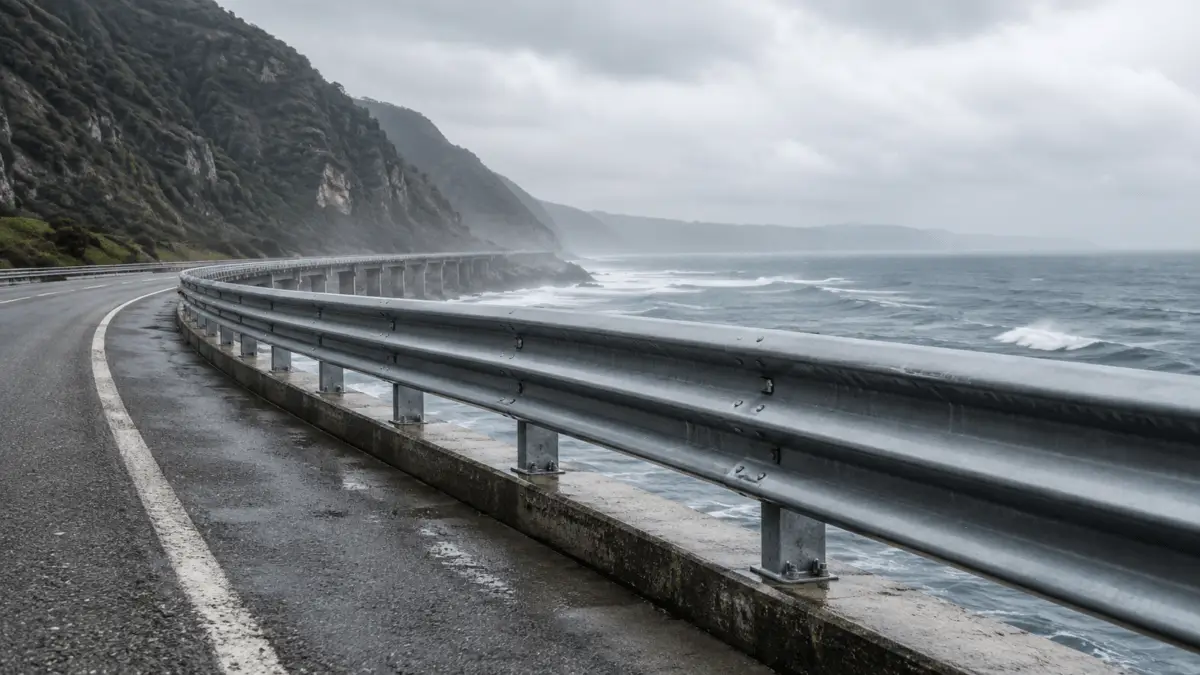
Coastal highways, sea-crossing bridges, ports, waterfront roads, chemical plants and wastewater facilities expose guardrails to salt spray, chlorides, humidity, industrial pollutants or de-icing salts. Corrosion often starts at holes, cut edges, welds, laps, bolts and the base of posts before it becomes visible across the beam surface.
For this reason, coastal guardrails should not be selected by panel price or appearance alone. The correct choice must match the environment, steel, coating, connections, installation and maintenance conditions.
Which Locations Are Highly Corrosive?
Typical examples include:
- coastlines, sea-crossing bridges and island roads;
- ports, terminals, yards and waterfront areas;
- estuaries, saline soil and hot-humid regions;
- chemical plants, wastewater facilities and industrial parks;
- roads where de-icing salts are used; and
- locations with standing water, poor drainage or persistent dampness.
The source of corrosion differs by location. Coastal roads are mainly exposed to salt spray and chlorides. Chemical and wastewater sites may contain acidic, alkaline or other aggressive media. De-icing salts can accumulate around the post base and connection details.
Four Main Corrosion-Protection Options
1. Hot-Dip Galvanized Guardrails
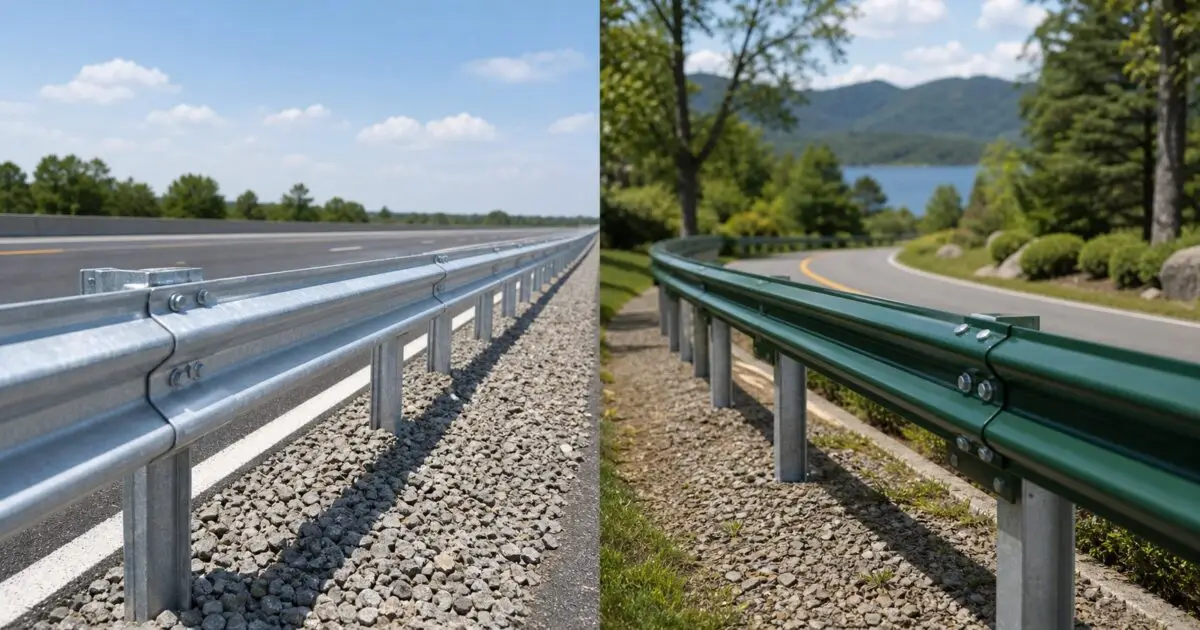
Hot-dip galvanized guardrails are widely used on ordinary roads and outdoor infrastructure. The zinc layer separates the steel from air and water and provides sacrificial protection at small damaged areas.
The purchaser should confirm:
- steel grade and component thickness;
- zinc coating mass or coating thickness;
- coating uniformity;
- coverage at holes, cut edges and welds; and
- repair procedures for damage during transport or installation.
Hot-dip galvanizing is a practical starting point for many coastal roads. Strong salt spray, long-term immersion or difficult maintenance may justify a duplex coating system.
2. Powder-Coated Guardrails
Powder coating provides a coloured protective surface and is often selected for urban roads, scenic routes, bridges and waterfront projects where appearance matters.
Check coating adhesion, edge and hole coverage, coating uniformity, repair procedures and powder compatibility with the environment. Powder coating provides barrier protection; it does not replace suitable steel or a properly designed underlying corrosion-protection system.
3. Duplex Coating: Galvanizing Plus Powder Coating
A duplex system combines hot-dip galvanizing with a powder or paint layer. It is suitable for strong salt exposure, limited maintenance access or projects requiring both corrosion protection and a controlled appearance.
Performance depends on surface preparation, adhesion, edge coverage, protection of bolts and connections, and the repair method for site damage. Cost is normally higher than a single coating, so the decision should follow the environment, design life, maintenance plan and budget.
4. Stainless Steel and Special Materials
Stainless steel and other special materials may suit severe waterfront or architectural applications. Their cost, strength, welding, connections and maintenance differ from ordinary carbon-steel guardrails.
Stainless steel is not an automatic substitute for a vehicle-crash barrier. Where the barrier must contain vehicles, the complete structure, connections, foundation and project requirements still need verification.
Where Corrosion Usually Starts
| Location | Typical risk |
|---|---|
| Beam laps | Water and salt remain in the joint and create crevice corrosion |
| Holes and cut edges | Coating is thinner or damaged during fabrication |
| Welds and heat-affected zones | Coating continuity is interrupted |
| Post bases | Water, soil and salt remain in contact with the steel |
| Bolts, nuts and washers | Coating damage or contact between dissimilar metals |
| Blockouts and connectors | Gaps make drainage and inspection difficult |
| Terminals and transitions | Complex geometry makes repair less consistent |
| Bridge bases and anchors | Poor drainage or persistent dampness |
The weak points of a guardrail system are often its connections and drainage details, not the middle of the beam panel.
Zinc Coating Mass and Coating Thickness Are Different Indicators
Two common procurement indicators are:
- g/m²: zinc mass per unit surface area;
- μm: coating thickness.
They are affected by surface condition, measurement location, coating density and test method. The contract should state which indicator, standard and test method apply.
Do not accept a simple statement such as “550 g/m² equals 85 μm” as the complete acceptance basis. Use the project specification and inspection report.
Selecting a Scheme by Project Environment
| Project environment | Initial option to evaluate | Main checks |
|---|---|---|
| Ordinary coastal highway | Hot-dip galvanizing | Coating indicator, holes and cut-edge treatment |
| Port, terminal or waterfront | Hot-dip galvanizing or duplex coating | Salt exposure, edges, bolts and maintenance |
| Scenic bridge or urban road | Powder coating or duplex coating | Colour, adhesion and repair |
| Chemical or wastewater site | Enhanced corrosion-protection system | Aggressive media, connectors and test records |
| De-icing salt region | Hot-dip galvanizing or duplex coating | Drainage, salt accumulation and winter maintenance |
What to Confirm with the Manufacturer
Before ordering, confirm:
1. steel grade, thickness and component list;
2. corrosion requirements for beams, posts and accessories;
3. coating mass or thickness and the test method;
4. powder type, colour and adhesion requirements;
5. protection of bolts, nuts, washers and anchors;
6. repair procedures for holes, cuts, welds and site damage;
7. salt-spray or corrosion-resistance records where required;
8. packing, transport and installation requirements; and
9. complete system drawings and acceptance documents.
Conclusion
Coastal and highly corrosive environments should not be reduced to a simple choice between galvanizing and powder coating.
Hot-dip galvanizing is a practical starting point for many coastal roads. Duplex coating deserves consideration where salt exposure is severe, maintenance access is limited or appearance is important. Chemical, wastewater and continuously wet locations require confirmation of the corrosive media and the complete protection system.
The final decision must cover the beam, posts, bolts, connectors, terminals, transitions and foundation. A guardrail will retain reliable protection in a corrosive environment only when its materials, coatings, connections and maintenance requirements are specified as one complete system.