China guardrail specifications
June 24, 2026
Guardrail Crash-Protection Levels and Crash-Test Conditions: China’s JTG B05-01 Compared with U.S., European and Japanese Standards
August 6, 2026
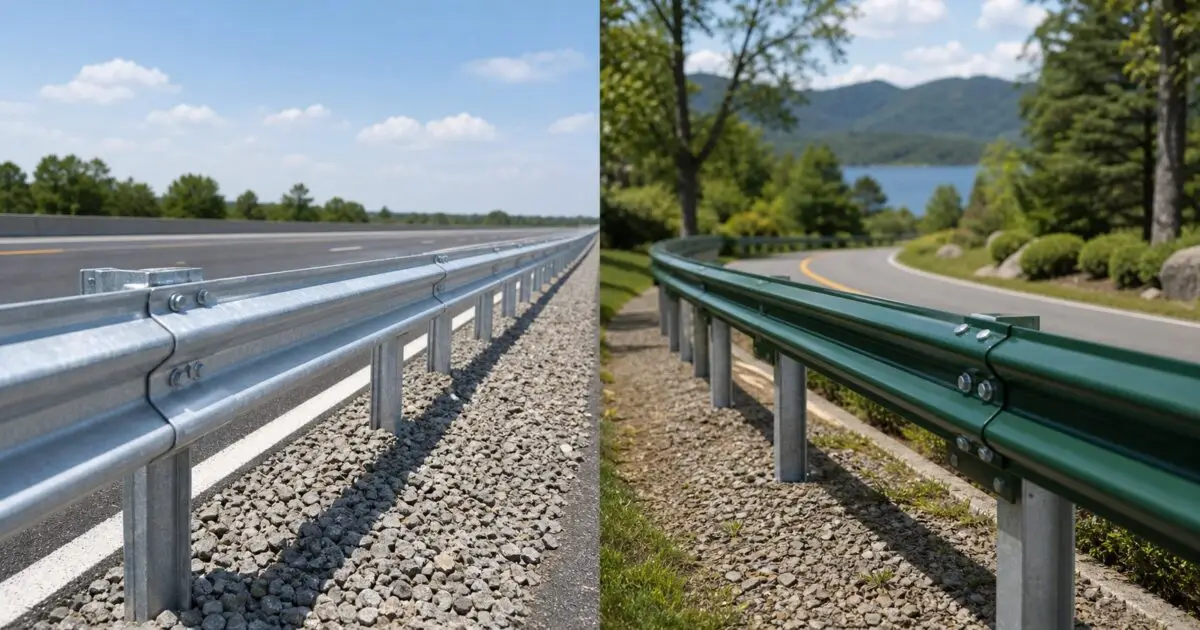
Hot-Dip Galvanized vs Powder-Coated Guardrail: Which Should You Choose?
Choosing between a hot-dip galvanized guardrail and a powder-coated guardrail is not simply a matter of selecting silver or green. The correct finish depends on the road environment, corrosion exposure, appearance requirements, maintenance plan and project specification.
For most highways, rural roads and remote infrastructure projects, hot-dip galvanizing is usually the practical choice because it provides durable zinc-based corrosion protection with relatively low maintenance requirements.
For scenic roads, urban streets, parks and other projects where color is important, a powder-coated finish may be preferred. For long-term outdoor infrastructure, however, the recommended solution is often a duplex coating system—powder coating applied over a properly prepared hot-dip galvanized surface—rather than powder coating applied directly to bare steel.
Quick Answer
- Choose hot-dip galvanized guardrail when durability, low maintenance and controlled lifecycle cost are the priorities.
- Choose powder-coated guardrail when the project requires a specific color or architectural appearance.
- Choose a galvanized-plus-powder duplex system when the project requires both long-term outdoor corrosion protection and a colored finish.
- Do not treat surface finish as a crash-performance level. Safety performance depends on the complete tested guardrail system.
What Is a Hot-Dip Galvanized Guardrail?
A hot-dip galvanized guardrail is protected by immersing prepared steel components in molten zinc. This process forms a bonded zinc coating on the steel surface.
Unlike a decorative finish that only creates an external barrier, zinc provides two forms of corrosion protection:
- Barrier protection: the zinc coating separates the steel from moisture and oxygen.
- Sacrificial protection: zinc can continue protecting nearby exposed steel when a small scratch or damaged area occurs.
This makes hot-dip galvanized highway guardrail suitable for large road networks, remote sections and projects where frequent repainting or maintenance would be difficult.
The current international specification for batch hot-dip galvanized fabricated iron and steel articles is ISO 1461:2022. Project-specific guardrail requirements may also refer to AASHTO M180, national product standards or the purchaser’s technical specification.
What Is a Powder-Coated Guardrail?
Powder coating is a dry finishing process. Electrically charged powder particles are sprayed onto a prepared metal surface and then cured to form a continuous coating.
Powder coating offers a wide range of colors and surface appearances. Green and brown guardrails are commonly selected for scenic highways, parks, forest roads and waterfront projects because they can blend more naturally into the surrounding landscape.
However, the term “powder-coated guardrail” does not describe the complete corrosion-protection system. Buyers should confirm what is underneath the powder coating.
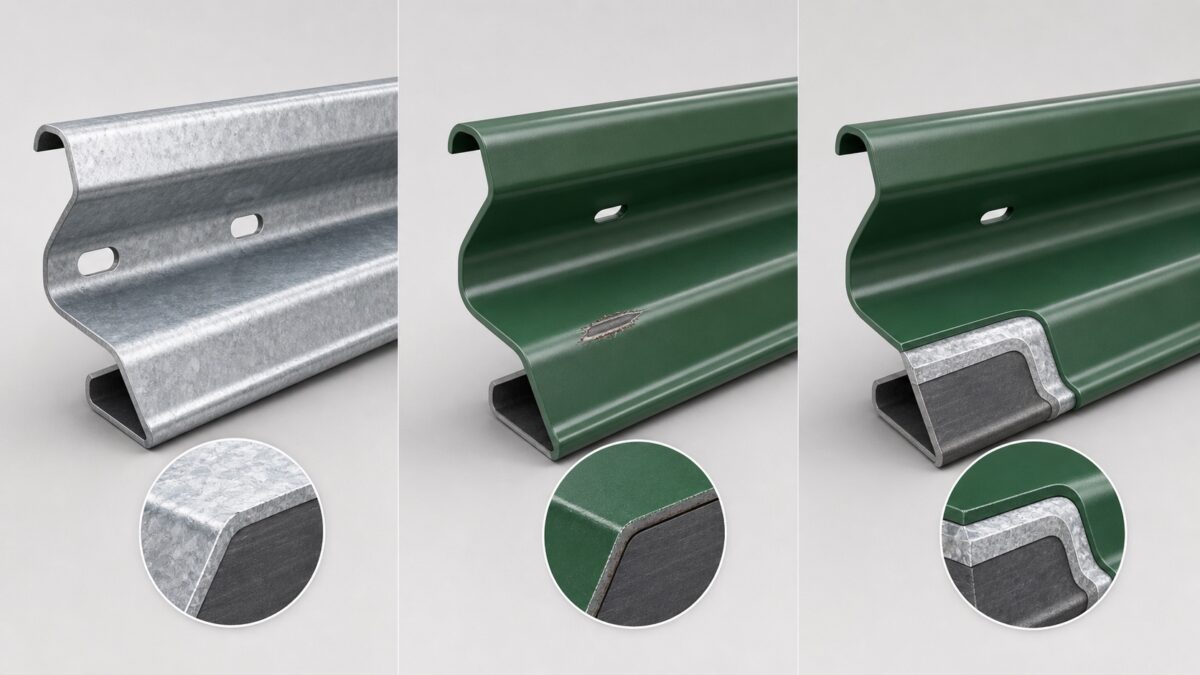
There are three different systems:
- Hot-dip galvanized guardrail without a colored topcoat.
- Powder coating applied directly to bare steel.
- Powder coating applied over hot-dip galvanized steel.
The third option is known as a duplex coating system. It combines the corrosion protection of zinc with the color and additional barrier protection of powder coating.
For permanent outdoor guardrail projects, powder coating over a galvanized substrate is normally more reliable than powder coating over bare steel.
Hot-Dip Galvanized or Powder-Coated: Which Is Better?
Neither finish is automatically better for every project. The correct selection depends on the operating environment and the buyer’s priorities.
Choose Hot-Dip Galvanized Guardrail When:
- The project is located on a conventional highway or rural road.
- Long-term corrosion protection is more important than color.
- The road is remote and maintenance access is limited.
- Guardrails may be exposed to stone impact, handling damage or roadside debris.
- The project requires a cost-effective finish for a large quantity.
- A silver or gray metallic appearance is acceptable.
Hot-dip galvanizing is generally the most straightforward choice for standard highway and median barrier projects.
Choose Powder-Coated Guardrail When:
- The project requires a specific color or architectural appearance.
- The guardrail will be installed on a scenic road, urban street or park route.
- The owner requires a custom RAL color.
- The barrier needs to coordinate with lighting poles, fencing or other municipal infrastructure.
- Additional barrier protection is required over an existing galvanized coating.
For outdoor infrastructure, buyers should specify whether the powder coating is applied over bare steel or over hot-dip galvanized steel.
Why a Duplex Coating System Is Different
A duplex system consists of hot-dip galvanizing followed by paint or powder coating.
The powder layer provides color and acts as an additional environmental barrier. The zinc coating underneath remains available to protect the steel if the external layer becomes damaged or reaches the end of its decorative service life.
Correctly specified duplex systems can extend corrosion protection and maintenance intervals beyond those of either coating used alone. Performance, however, depends heavily on surface preparation and coating compatibility.
The galvanized surface must be clean, dry and properly prepared before powder coating. Contaminants, zinc corrosion products, unsuitable passivation treatments or an incorrect surface profile can cause poor adhesion, blistering or peeling.
ASTM D7803-25 specifically addresses the preparation of hot-dip galvanized iron and steel surfaces before powder coating.
When ordering a duplex guardrail system, buyers should confirm:
- The condition of the galvanized surface before coating.
- Cleaning and surface-profiling methods.
- Whether passivation or quenching treatments were used.
- Powder resin type and suitability for exterior use.
- Powder-coating thickness and curing conditions.
- Adhesion and appearance inspection.
- Repair procedures for damaged areas.
Corrosion Resistance
Hot-dip galvanizing is normally selected for its zinc-based corrosion protection. Performance depends on zinc coating thickness, coating quality and the corrosiveness of the service environment.
Powder coating provides barrier protection. If powder is applied directly to bare steel and the coating is deeply scratched, corrosion can begin at the exposed area and may spread beneath the coating.
When powder coating is applied over galvanized steel, the zinc layer provides a second level of protection. This is particularly useful when both color and long-term outdoor durability are required.
Coastal roads, industrial zones, areas using de-icing salts and environments with high humidity require more careful coating selection. A generic statement such as “powder coated” is not sufficient. The purchaser should define the complete coating system, inspection requirements and maintenance expectations.
Appearance and Color Selection
Hot-dip galvanized guardrails normally have a bright silver or matte gray appearance. Differences in zinc surface appearance do not necessarily indicate a difference in corrosion performance, provided the coating satisfies the specified inspection requirements.
Powder coating provides greater visual flexibility. Common options include:
- Green for forest and scenic roads.
- Brown for parks and natural landscapes.
- Black or gray for urban and architectural projects.
- Blue or other designated municipal colors.
- Custom RAL colors for project-specific requirements.
Color should be selected with consideration for outdoor UV exposure, surrounding structures and long-term color stability. An exterior-grade, UV-resistant powder should be specified for outdoor guardrail applications.
Maintenance and Repair
Hot-dip galvanized guardrails generally require limited routine maintenance, but they should still be inspected after vehicle impacts, installation damage or long-term exposure to aggressive environments.
Powder-coated guardrails require inspection of both the colored surface and the underlying corrosion-protection system. Areas around bolts, edges, drainage points and impact damage deserve particular attention.
Repairing only the visible color without restoring the underlying corrosion protection may leave the steel vulnerable. The maintenance plan should address:
- Impact-damaged sections.
- Cut edges or field-drilled holes.
- Scratched coating.
- Loose or replaced bolts.
- Powder-coating adhesion.
- Zinc coating repair.
- Color matching for replacement components.
Does the Finish Change the Guardrail’s Safety Level?
The finish alone does not create a crash-performance level.
Guardrail safety performance depends on the complete system, including:
- W-Beam or Thrie-Beam profile.
- Steel grade and base-metal thickness.
- Beam and post dimensions.
- Post spacing.
- Blockouts, brackets and fasteners.
- End terminals.
- Installation conditions.
- The exact tested or approved configuration.
EN 1317 relates to road-restraint-system crash performance. AASHTO M180 addresses requirements for corrugated sheet steel beams, while MASH provides crash-test evaluation criteria for roadside safety hardware.
A colored finish should not be presented as an independent EN 1317 or MASH certification. Buyers should confirm that any change in coating, component geometry or installation arrangement remains compatible with the approved project system.
Current Chinese Guardrail and Coating Standards
For projects referencing Chinese standards, buyers should note that the 2015 editions of the corrugated steel guardrail standards have been replaced.
The current standards, effective from March 1, 2026, include:
- GB/T 31439.1—2025: Corrugated Sheet Steel Beams for Road Guardrail—Part 1: W-Beam Guardrail.
- GB/T 31439.2—2025: Corrugated Sheet Steel Beams for Road Guardrail—Part 2: Thrie-Beam Guardrail.
- GB/T 18226—2025: Specification for Steel Component Anticorrosion of Highway Traffic Engineering.
International projects may additionally specify ISO 1461:2022, ASTM coating practices, AASHTO requirements or destination-country standards.
The purchase order should identify the exact standard edition rather than stating only “international standard” or “galvanized according to standard.”
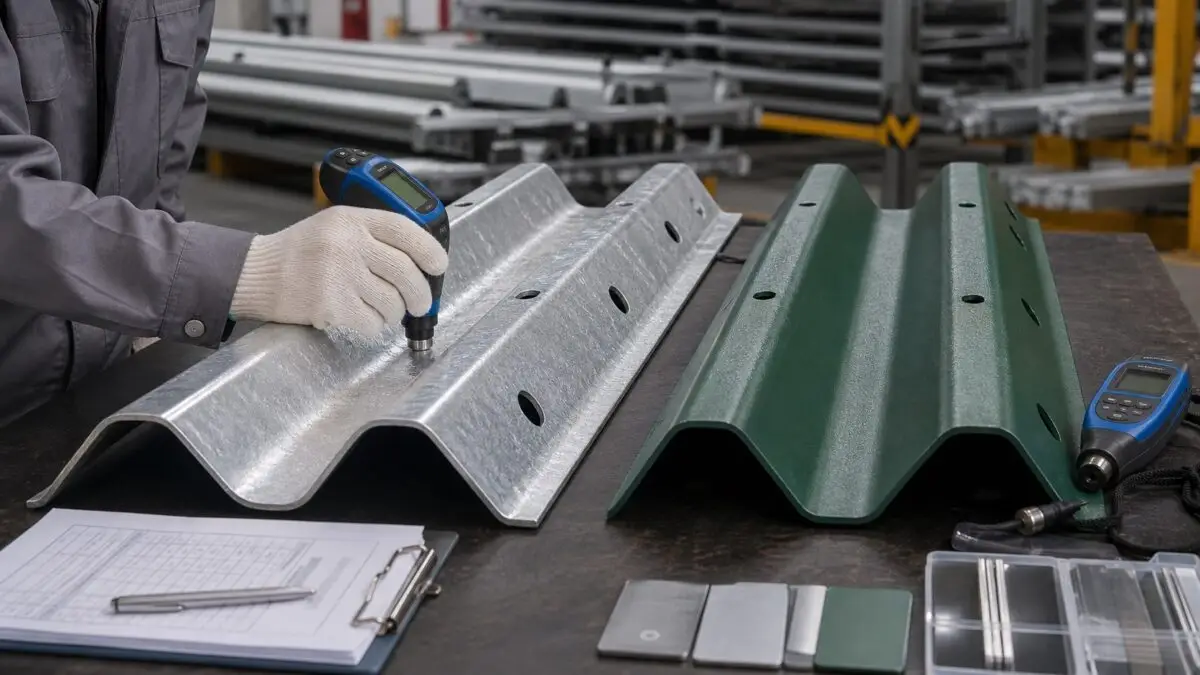
ickness inspection for hot-dip galvanized and powder-coated highway guardrails.
Coating Weight Figures: What Each Standard Actually Requires
The purchase order has to say what coating is wanted, and there are two ways to say it: by mass in g/m², or by thickness in µm. Both are legitimate. The problem is that the figure alone does not identify the standard it came from, and the standards do not require the same thing.
Three figures appear regularly on guardrail enquiries. Only two of them come from AASHTO M180.
| Figure | Standard and designation | What it means |
|---|---|---|
| 550 g/m² | AASHTO M180, Type I | Minimum single-spot coating weight, both sides combined |
| 1,100 g/m² | AASHTO M180, Type II | Roughly double Type I; for longer service life or aggressive exposure |
| 610 g/m² | ISO 1461 — not M180 | The mass equivalent of the 85 µm mean thickness that ISO 1461 requires for steel over 6 mm |
The conversion behind the third figure is fixed arithmetic: zinc density is about 7.14 g/cm³, so 85 µm × 7.14 ≈ 607 g/m². Buyers can check any coating claim with that calculation.
What matters when ordering is the thickness band, and the fact that ISO 1461 states two figures per band — a local minimum and a mean minimum. For steel over 6 mm those are 70 µm local and 85 µm mean. For the 3 mm to 6 mm band — where guardrail beams sit — they are 55 µm local and 70 µm mean, approximately 395 and 505 g/m². Both are below the AASHTO M180 Type I baseline of 550 g/m². So an order that says “galvanized to ISO 1461” without qualification can specify less zinc than M180 Type I, on a beam that is too thin to qualify for the 85 µm figure in the first place.
How to write the coating requirement so quotations compare
The clause needs four elements. Without all four, two suppliers can both claim compliance and deliver different coatings.
The value and its unit. State whether the requirement is a mass (g/m²) or a thickness (µm). Do not leave it to the supplier to choose the easier one.
The standard it is drawn from. Name AASHTO M180 Type I, or AASHTO M180 Type II, or ISO 1461 with the applicable thickness band — not simply “galvanized to standard.”
The test method. Stripping and weighing, or magnetic thickness gauge readings, with the number and location of measurement points defined.
The record to be supplied. State which documents arrive with the shipment: coating test records, dimensional records, mill certificates, packing list.
Weak versus workable wording
| Wording | What is wrong or right about it |
|---|---|
| Hot dip galvanized to ISO 1461 | Incomplete. On a 3 mm beam this falls below M180 Type I while appearing stricter. Also ambiguous — ISO 1461 gives two figures per band. |
| Galvanized to international standard | Names no standard, no value and no test method. Not an acceptance criterion. |
| Coating weight 550 g/m² minimum, both sides combined, single-spot, AASHTO M180 Type I | Workable. Value, basis, standard and designation are all stated. |
| Coating weight 610 g/m² minimum, both sides combined, single-spot, verified by stripping and weighing | Workable. Stated as a project requirement, with the test method and the measurement basis named. |
The last row is worth noting for coastal and high-corrosion projects. Specifying above the M180 Type I baseline is a legitimate way to buy a longer maintenance interval — provided it is written as a project requirement with the test method attached, and not described as an M180 Type I figure, because it is not one.
Verifying the coating before award
Three checks close most of the gap between a coating claim and a coating delivered.
- Ask for the test method, not only the value. A supplier who can name the method and the measurement points is working from a defined acceptance basis. A supplier who can only repeat the figure is not.
- Check the beam thickness first. The applicable ISO 1461 band depends on it, so the thickness has to be established before the coating requirement can be interpreted at all.
- Ask what evidence arrives with the goods. Mill certificates do not demonstrate coating mass. Test records do. Establish which one is being offered before the order is placed, not after delivery.
For the corrosion-environment side of the same decision — which coating system suits which exposure — see our guide to guardrails for coastal and highly corrosive environments. For how coating sits within the wider material specification, see our notes on steel grade selection.
Guardrail Finish Procurement Checklist
Before requesting a quotation, provide the manufacturer with:
- Guardrail type: W-Beam or Thrie-Beam.
- Base-metal thickness and steel grade.
- Required product and coating standard.
- Hot-dip galvanized, powder-coated or duplex finish.
05. Coating requirement — value, unit, source standard and test method. State the coating as a mass (g/m²) or a thickness (µm), name the standard it is drawn from, and specify how it will be verified. Useful wording, adaptable to the project:
- For M180 baseline: “Coating weight 550 g/m² minimum, both sides combined, single-spot, AASHTO M180 Type I, verified by stripping and weighing.”
- For extended service life: “Coating weight 610 g/m² minimum, both sides combined, single-spot, verified by magnetic thickness gauge at [n] defined points per panel, converted to mass at 7.14 g/cm³.”
Avoid “hot dip galvanized to ISO 1461” without the thickness band and without saying which of the two figures applies. ISO 1461 states a local minimum and a mean minimum for each band: for steel over 6 mm these are 70 µm and 85 µm; for steel between 3 mm and 6 mm — which includes standard W-beam at 2.5 mm to 4.0 mm — they are 55 µm and 70 µm, approximately 395 and 505 g/m². Both sit below the AASHTO M180 Type I baseline of 550 g/m².
- Powder type and required coating thickness.
- RAL color, gloss level and surface appearance.
- Road environment and corrosion exposure.
- Beam length, hole spacing and curved-panel requirements.
- Matching posts, blockouts, bolts and terminals.
- Inspection and documentation requirements.
- Order quantity, packing method and destination port.
A clear coating specification reduces pricing differences, prevents the substitution of powder-only steel for a duplex system and makes supplier quotations easier to compare.
Frequently Asked Questions
Is Powder-Coated Guardrail More Corrosion-Resistant Than Galvanized Guardrail?
Not automatically. Powder coating over bare steel provides barrier protection, but damage can expose the steel. A correctly prepared duplex system—powder coating over hot-dip galvanized steel—can provide more comprehensive protection than either system used alone.
Can a Galvanized Guardrail Be Supplied in a Custom Color?
Yes. A compatible powder coating or paint system can be applied over a properly prepared galvanized surface. Custom RAL colors are available for project-specific requirements.
Is Powder-Coated Guardrail Cheaper?
A properly manufactured duplex guardrail usually costs more initially because it requires both galvanizing and powder coating. Powder coating directly over bare steel may be less expensive, but it should not be treated as equivalent corrosion protection.
Which Finish Is Better for Scenic Roads?
A galvanized-plus-powder duplex system is usually the appropriate option when the project requires both a landscape-compatible color and durable outdoor corrosion protection.
Which Finish Is Better for Ordinary Highways?
Hot-dip galvanized guardrail is normally the practical choice when color is not required and the priorities are durability, straightforward inspection and controlled lifecycle cost.
Which Finish Is Better for Coastal or Highly Corrosive Environments?
The coating system should be selected specifically for the project environment. A duplex system may be appropriate, but the required zinc layer, powder system, surface preparation and inspection method must be confirmed. A generic “powder-coated” description is not enough for coastal or high-salt exposure.
Get a Project-Specific Recommendation
The correct finish should be selected according to the project environment—not appearance alone.
China Guardrail supplies hot-dip galvanized W-Beam and Thrie-Beam systems as well as custom powder-coated guardrails in green, brown, blue and project-specific RAL colors.
Send us your required standard, drawings, coating specification, quantity and destination port. Our team will evaluate whether hot-dip galvanizing, powder coating or a duplex coating system is the appropriate option for your project.
View our highway guardrail products: https://chinaguardrail.com/product/
Contact factory sales: https://chinaguardrail.com/contact/
Engineering note: This article is intended for general product-selection reference. Final specifications must follow the project drawings, applicable standard editions and the approved guardrail system.
Standards and Sources Referenced
The specifications and requirements discussed in this article are drawn from the following published standards and official guidance:
- AASHTO M180 — Standard Specification for Corrugated Sheet Steel Beams for Highway Guardrail. https://store.transportation.org/Item/PublicationDetail?ID=4140
- ASTM A123/A123M — Standard Specification for Zinc (Hot-Dip Galvanized) Coatings on Iron and Steel Products. https://store.astm.org/search.html?query=A123
- GB/T 31439 national standard lookup — Official Chinese national standards database entry for GB/T 31439. https://openstd.samr.gov.cn/bzgk/std/std_list?p.p1=0&p.p90=circulation_date&p.p91=desc&p.p2=31439
- FHWA Roadway Departure Safety — Federal programme covering roadway departure crashes and roadside hardware. https://highways.dot.gov/safety/roadway-departure