Guardrail Crash-Protection Levels and Crash-Test Conditions: China’s JTG B05-01 Compared with U.S., European and Japanese Standards
August 6, 2026
Bridge and Waterfront Guardrail Safety Requirements: Containment Levels, Anchorage and Project Acceptance
August 18, 2026
Quick answer
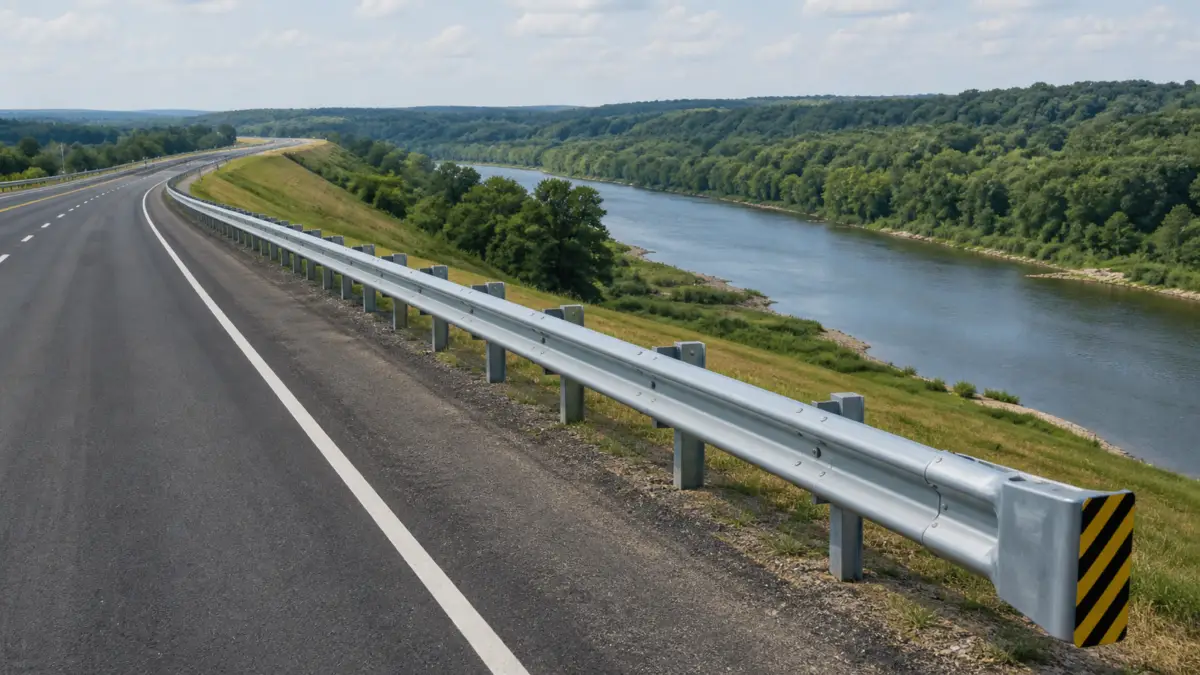
Highway guardrails are not installed simply because a road has a shoulder or a slope. Under China’s JTG D81-2017, the decision starts with the available clear zone (FHWA roadside-departure guidance) and the risk created by roadside hazards. A guardrail is generally required when a vehicle leaving the roadway could reach a railway, deep water, a high embankment, a bridge pier, a dangerous facility or another obstacle that cannot be safely crossed.
The practical sequence is:
- Check whether the roadside clear zone is adequate.
- Identify hazards that a vehicle cannot safely traverse.
- Assess the likelihood and severity of a run-off-road crash.
- Decide whether a guardrail or another safety treatment is needed.
- Select the protection level and verify dynamic deflection, foundation and installation conditions.
1. What is the clear zone?
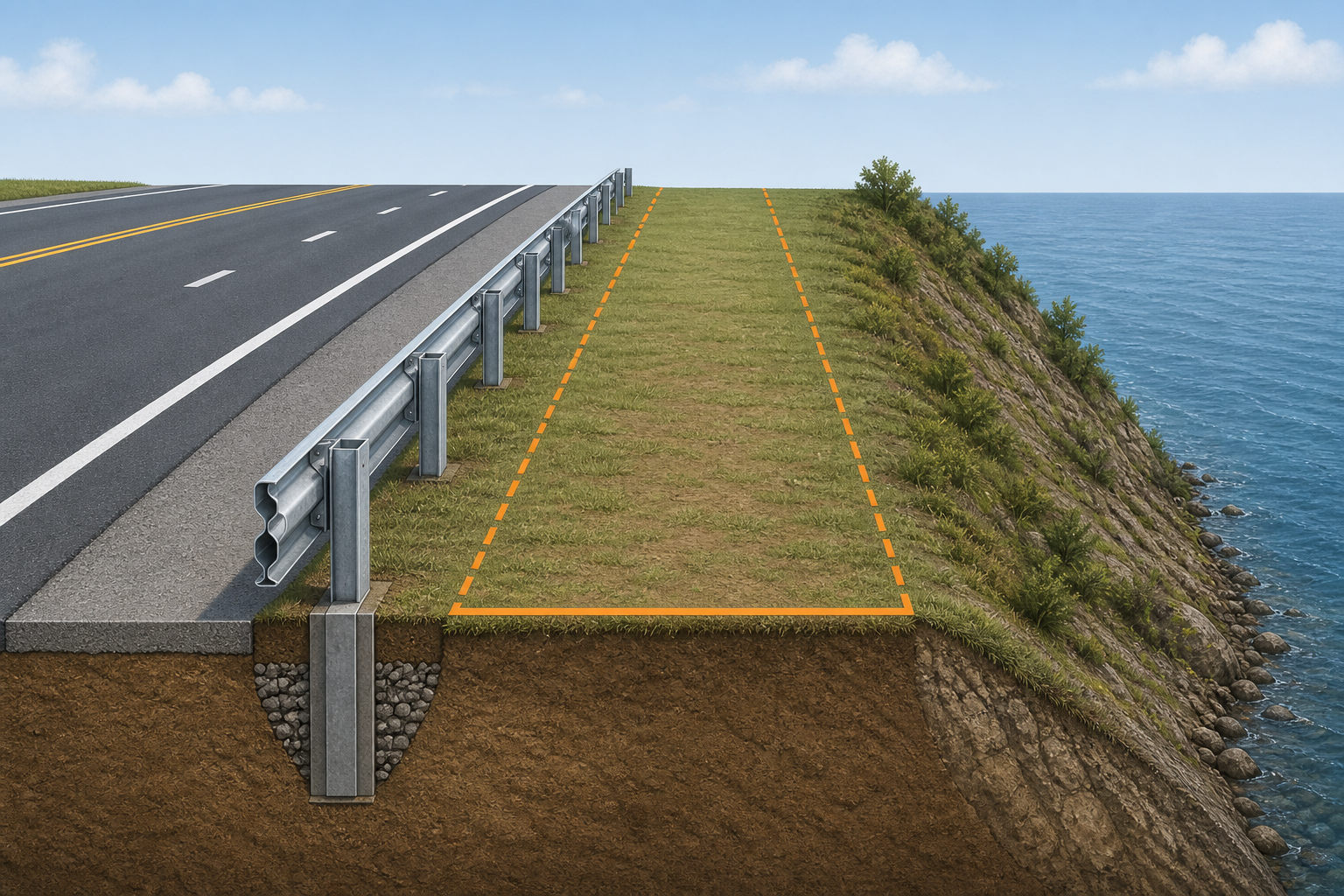
The clear zone is the usable roadside area outside the traveled way where an errant vehicle may slow down, recover control or reduce the severity of a crash. It is not simply the paved shoulder width.
If the area contains no serious hazard, a vehicle that leaves the lane may have room to decelerate or recover. If the area contains a deep ditch, steep drop-off, water, railway, bridge pier or other rigid obstacle, the consequences of a run-off-road event can be much more severe.
JTG D81-2017 requires the road and median to use a reasonable clear zone to reduce the consequences of vehicles leaving the roadway or entering opposing traffic. When the clear zone cannot be achieved, the designer must apply an appropriate safety treatment. A guardrail is one of the principal treatments, but the final decision still depends on the site risk.
2. What determines roadside risk?
JTG D81-2017 evaluates roadside risk by considering both the likelihood of a vehicle leaving the roadway and the severity of the resulting crash. The main factors are:
2.1 Likelihood of a run-off-road event
- Horizontal and vertical alignment;
- design speed and operating speed;
- traffic volume;
- the proportion of heavy vehicles;
- shoulder, pavement and drainage conditions; and
- rain, snow, ice, wind and other environmental conditions.
Sharp curves, long downgrades, narrow shoulders and a high proportion of heavy vehicles can increase the likelihood of a vehicle leaving the roadway.
2.2 Consequences after a vehicle leaves the road
The same roadside feature may create different levels of risk in different locations. A shallow ditch is not equivalent to a deep river. A normal sign support is not equivalent to a high-speed railway, a bridge pier or a high embankment.
The assessment should consider the obstacle, the vehicle path, the distance from the roadway, the operating speed and the consequences for other road users.
2.3 Road class and design speed
Road class and design speed influence the minimum protection level. Expressways, first-class highways, bridges and other high-consequence locations generally require stronger protection than low-speed, low-volume roads.
Protection level cannot be selected from the appearance of the W-beam or from beam thickness alone. It must match the road risk and the complete guardrail system configuration.
3. When is a guardrail normally required?
Under Section 6.2.3 of JTG D81-2017, the following roadside conditions are treated as high-severity situations where a guardrail is required:
- a high-speed railway within the calculated clear zone;
- an expressway within the calculated clear zone;
- a high-voltage transmission tower within the calculated clear zone; or
- a dangerous-goods storage facility or another similarly high-risk installation within the clear zone.
These locations can create serious secondary accidents if struck. Warning signs or a wider shoulder should not be treated as automatic substitutes for a tested roadside barrier system.
4. Roadside conditions that should receive guardrail protection
Section 6.2.4 of JTG D81-2017 identifies roadside conditions that should normally be protected:
| Roadside condition | Main safety concern |
|---|---|
| A high embankment or steep slope on a second-class or higher highway that falls within the risk zones defined by JTG D81-2017 | The vehicle may not recover and may fall or overturn |
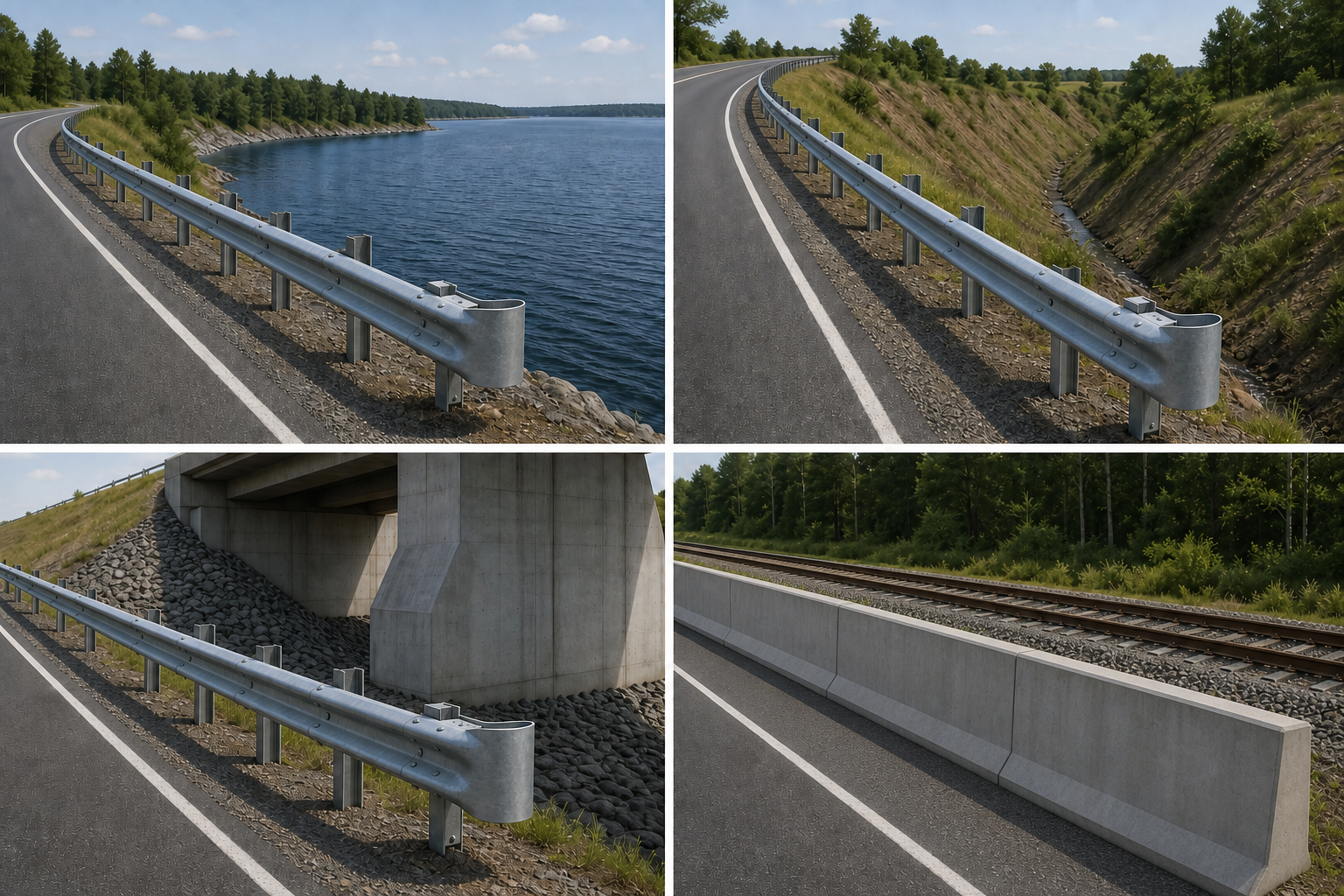
| A cliff, deep valley or deep ditch more than 30 m high beside a third- or fourth-class highway | A run-off-road crash may cause a severe fall |
| A river, lake, sea, marsh or other water body deeper than 1.5 m | The vehicle may enter the water, making escape and rescue difficult |
| A Class I railway or a first-class highway beside the road | A vehicle may conflict with trains or opposing traffic |
| A roadside facility that a vehicle cannot safely traverse on an expressway or first-class highway | Examples include lighting poles, cameras, signs, noise barriers, bridge piers and abutments |
| An unprotected tunnel entrance, maintenance walkway or portal structure | A vehicle leaving the lane may strike a rigid structure directly |
The phrase “should be protected” does not remove the need for engineering judgment. The road cross-section, obstacle position, traffic mix, operating speed and local acceptance requirements still need to be checked.
5. Roadside conditions that should be evaluated for additional protection
Section 6.2.5 of JTG D81-2017 also identifies lower-severity conditions where guardrail protection is generally recommended:
- an uncovered side ditch on a second-class or higher highway that a vehicle cannot safely cross;
- a concrete structure or large boulder more than 300 mm above the road surface or cut slope; and
- an obstacle in the triangular area at a ramp exit.
“Recommended” does not mean “ignore the site.” A low-speed road with little traffic may require a different treatment from a high-speed road carrying a large number of heavy vehicles.
6. How is the protection level selected?
Once the need for protection has been established, the designer should verify:
- highway class;
- design speed;
- accident-severity category;
- traffic composition and heavy-vehicle percentage;
- roadside obstacle type;
- allowable guardrail deflection; and
- the distance between the guardrail and the protected obstacle.
JTG D81-2017 Table 6.2.10 selects roadbed guardrail protection levels by combining highway class, design speed and accident severity. The table is a starting point for design; the final system must also satisfy the applicable safety-performance evaluation and project approval requirements.
The protection level may need to be increased where the crash likelihood or consequences are higher, including:
- a downgrade near the maximum grade permitted for the highway;
- the outside of a curve near the minimum radius permitted for the highway; or
- a traffic stream in which vehicles with a gross mass of at least 25 tonnes exceed 20% of the design traffic.
For a low-volume road with an average daily traffic volume below 2,000 passenger cars and a design speed no higher than 60 km/h, JTG D81-2017 allows a traffic-safety and economic analysis before deciding whether to install a guardrail and which level to use. If the level is reduced after that analysis, it should not fall below Level 1 (C).
7. Why dynamic deflection must be checked
A W-beam guardrail is a semi-rigid system. The beam, posts, blockouts, soil and connections work together to absorb crash energy through controlled deformation.
For this reason, the following must be checked separately:
- the clear zone used to decide whether roadside protection is needed;
- the maximum lateral dynamic deflection of the guardrail;
- the maximum dynamic vehicle overhang or vehicle roll-out effect; and
- the distance from the guardrail face to the protected obstacle.
The clear-zone decision and the post-installation obstacle clearance are related, but they are not the same calculation. A guardrail installed too close to a bridge pier, railway, deep ditch or water body may still allow the vehicle or the deformed system to reach the hazard.
The U.S. AASHTO Roadside Design Guide also organizes roadside safety around clear zones, roadside obstacles, barrier selection, deflection, transitions, site conditions and maintenance. The principle is consistent: the barrier must be selected and installed as a complete system for the actual site.
8. Guardrail installation conditions that affect performance
A protection level cannot be preserved by changing only one component. The following details must be checked against the approved system drawing:
- beam profile and thickness;
- post section, spacing, length and embedment;
- blockouts, brackets and splice connections;
- bolts, nuts and washers;
- terminals and transitions;
- soil, rock or concrete foundation conditions;
- shoulder width and edge distance; and
- galvanizing or other corrosion-protection requirements.
When the soil compaction or shoulder conditions do not meet the guardrail installation requirements, strengthening or another foundation solution may be necessary. JTG D81-2017 also requires transitions where different guardrail structures or protection levels connect.
9. What should be included in a guardrail quotation request?
| Information for quotation | Details to confirm |
|---|---|
| Project location | Country, region, climate and exposure conditions |
| Road information | Highway class, design speed, traffic volume and heavy-vehicle share |
| Roadside hazard | Water, slope, ditch, railway, bridge pier, structure or other obstacle |
| Safety requirement | Target protection level and applicable standard |
| System configuration | Beam, posts, blockouts, brackets, bolts, terminals and transitions |
| Installation basis | Spacing, embedment, soil, concrete foundation, shoulder and edge distance |
| Deflection requirement | Allowed dynamic deflection and obstacle clearance |
| Surface protection | Hot-dip galvanizing, powder coating or another specified system |
| Project documents | Drawings, material certificates, inspection reports and installation guidance |
If a supplier receives only a product photograph or a request for a certain beam thickness, it cannot reliably confirm whether the complete guardrail system is suitable for the site.
10. Frequently asked questions
Does every roadside need a guardrail?
No. The decision depends on clear-zone width, roadside hazards, traffic conditions, operating speed and crash severity. A guardrail is not automatically required on every road edge.
If there is no obstacle, can the guardrail be omitted?
Not automatically. The designer should still assess slopes, drainage, traffic mix, road geometry and the available recovery area. The absence of one obvious obstacle does not replace a complete roadside-risk assessment.
Can a lower design speed automatically reduce the protection level?
No. Design speed is one factor. Road class, accident severity, heavy-vehicle share, obstacle type and project approval requirements must also be considered.
Can a supplier replace the existing posts with another profile?
Not without checking the complete system. Post profile, spacing, embedment, blockout, hole pattern and foundation conditions affect crash performance. A substitute component should be confirmed against the approved drawing or tested system configuration.
Conclusion
The correct sequence for a highway guardrail decision is:
- assess the clear zone;
- identify roadside hazards;
- evaluate the likelihood and severity of a run-off-road crash;
- decide whether guardrail protection or another treatment is needed;
- select the protection level;
- verify dynamic deflection and obstacle clearance; and
- confirm the complete system, foundation and installation details.
A guardrail is not an independent steel product. The beam, posts, blockouts, connections, terminals, foundation and installation conditions must work together as one safety system.
For a quotation, send the project location, highway class, design speed, guardrail length, roadside hazard, target standard and BOQ. China Guardrail can then review the system configuration, material, corrosion protection, inspection documents and project quotation.
Technical references and related resources
- JTG D81-2017: Highway Traffic Safety Facility Design Specifications.
- JTG B05-01: Roadside Safety Performance Evaluation Standard. JTG D81 addresses placement and design conditions; JTG B05-01 addresses safety-performance evaluation and crash testing.
- DB32/T 4512-2023: Design Specifications for High-Strength Steel Corrugated Beam Guardrails.
- Highway Guardrail Posts
- W-Beam vs. Thrie-Beam Guardrails
- Hot-Dip Galvanized vs. Powder-Coated Guardrails
- Contact China Guardrail
Standards and Sources Referenced
The specifications and requirements discussed in this article are drawn from the following published standards and official guidance:
- FHWA Guardrail guidance — FHWA’s own guidance on guardrail systems and their selection. https://highways.dot.gov/safety/roadway-departure/guardrail
- FHWA Highway Design Handbook, Chapter 10 — Roadside hardware chapter of the FHWA highway design handbook. https://highways.fhwa.dot.gov/sites/fhwa.dot.gov/files/Chapter_10_2.pdf
- Transportation Research Board — National research body behind NCHRP roadside-safety research. https://www.trb.org/
- AASHTO Publications — AASHTO’s official standards and publications catalogue. https://store.transportation.org/