China Updates Desert Highway Standard: Guardrails and Wind-Blown Sand
September 29, 2026
Road Resurfacing and Guardrail Performance: When to Reassess the Existing System
October 4, 2026
Motorcycle-Friendly Guardrails on Ordinary Roads: Reducing Secondary Injuries on High-Motorcycle-Traffic Routes
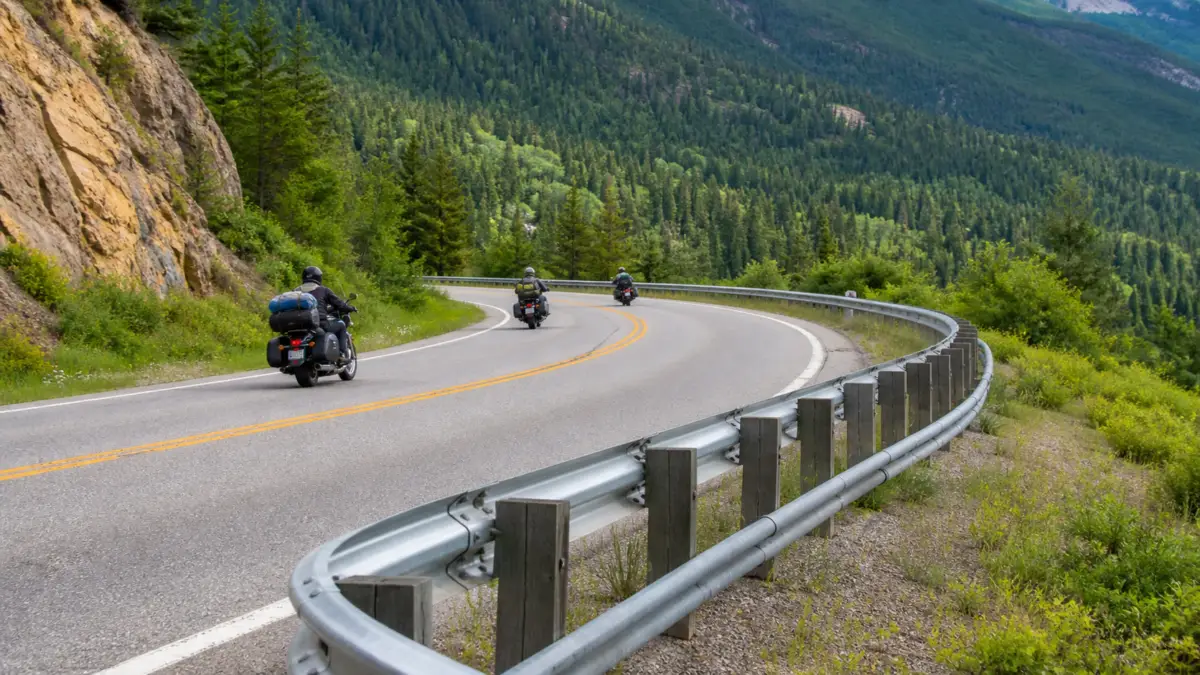
On mountain roads, scenic routes and ordinary national or provincial roads, motorcycles share the roadway with cars and trucks. When a motorcycle loses control, the rider may separate from the vehicle and slide toward the roadside barrier. A post, terminal or gap beneath the rail can then cause a second impact.
Traditional barriers are primarily designed for vehicle containment. On routes with substantial motorcycle traffic, the practical approach is to keep the vehicle barrier as the primary system and add motorcycle-oriented protection where the roadside risk requires it.
Protection Measures for Motorcyclists
1. Locations with Clear Space Behind the Barrier
Where the area behind the barrier provides a recovery zone rather than a direct drop, an auxiliary barrier can be added below the existing vehicle barrier.
Depending on the road cross-section, foundation and project requirements, the auxiliary system may be rigid, semi-rigid or flexible. A continuous lower rail or panel can shield the main posts, reduce direct post impact and reduce the chance of a sliding rider passing beneath the barrier.
2. Cliffs, Steep Slopes and High-Drop Locations
At cliff edges, deep ditches, rivers and steep embankments, the priority is to prevent a rider or vehicle from going over the edge. A rigid barrier or rigid protective structure can be added to the vehicle barrier to provide a stable containment face.
The connection to the vehicle barrier, bridge, retaining wall and foundation must be designed as one continuous transition. Height changes, anchorage and the start and end points require particular attention.
3. Continuous Lower-Rail Terminals and Transitions
The lower auxiliary barrier should not stop abruptly. Its start, end, connections and transitions must be continuous and protected.
Designs should avoid exposed steel ends, sharp projections, abrupt height changes and gaps that could snag a rider or motorcycle. Where the auxiliary barrier changes from semi-rigid or flexible construction to a rigid barrier, the transition should be treated as a complete system.
Design Requirements for Auxiliary Barriers
The existing vehicle barrier remains the primary safety system. The auxiliary barrier must not replace or weaken its vehicle-containment and redirection function.
- Keep the main beam, posts, terminals and foundations within their approved configuration.
- Check compatibility with the main posts, connections and foundation.
- Maintain a continuous, smooth lower protection surface.
- Provide defined terminal and transition details.
- Use materials and connections suitable for inspection, repair and replacement.
- Verify the combined system with applicable vehicle and motorcycle safety evidence.
FHWA describes a guardrail as a complete system of beams, posts, soil, connections, terminals and anchorage, not as a single beam. FHWA Guardrail 101
Roads That Should Be Prioritized
Priority should be given to ordinary roads with high motorcycle traffic, mountain hairpin bends, continuous downhill sections, scenic and touring routes, cliffside or riverside edges, documented motorcycle crashes, exposed posts or large gaps beneath the existing rail.
Projects should be selected by motorcycle traffic, crash history, road geometry and roadside hazard. A blanket replacement of every barrier is not necessary.
Conclusion
Motorcycle-friendly protection on ordinary roads should be added to an existing vehicle barrier, not used as a substitute for it.
Where clear space exists behind the barrier, a rigid, semi-rigid or flexible auxiliary system may be selected according to site conditions. At cliffs, steep slopes and high-drop locations, a rigid protective structure is more appropriate. Lower auxiliary-barrier terminals, connections and transitions must remain continuous and use suitable buffering details.
The objective is to preserve the vehicle barrier’s containment and redirection performance while reducing the chance that a sliding motorcyclist will strike a post, pass beneath the barrier or go over the roadside edge.
References: European Road Safety Observatory: Guard Rails; FHWA Motorcycle Safety; PIARC Motorcycle Protection Systems.
/image/image