
China Guardrail Factory
13 6 月, 2026
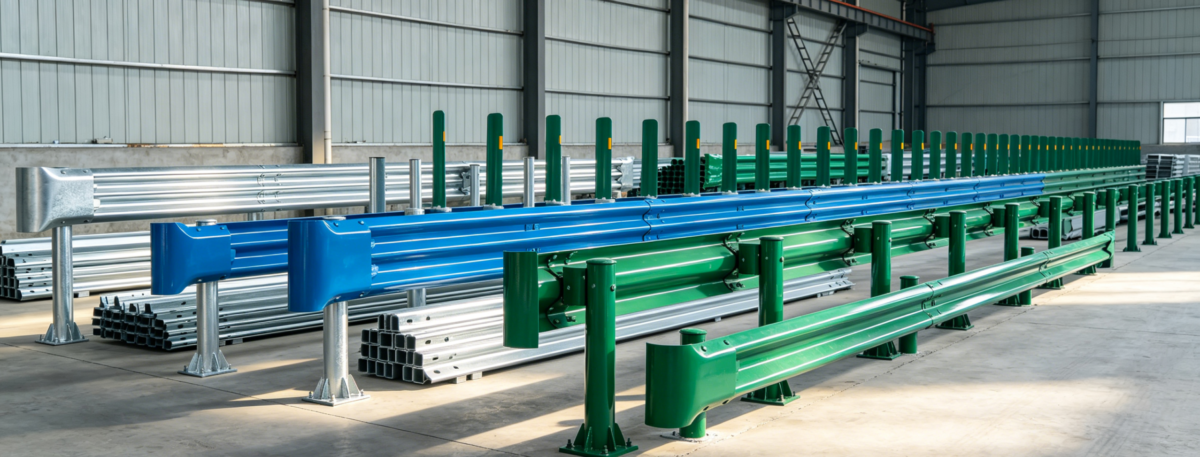
China has established itself as the world’s leading producer and exporter of highway guardrail systems. With a highly concentrated industrial base, stable production capacity, and decades of manufacturing expertise, Chinese factories have become the preferred sourcing destination for infrastructure contractors and trading companies worldwide.
Four Core Advantages of Chinese Guardrail Products
China’s guardrail supply chain offers four compelling advantages for international buyers.
Production scale. Fully automated rolling lines enable large-batch output, allowing factories to fulfill full-container orders on short lead times.
Surface treatment options. Chinese manufacturers support hot-dip galvanizing, powder coating, and epoxy zinc-rich primer finishes — covering the full range of corrosion protection requirements for outdoor road environments globally.
Product range. W-beam (two-wave), Thrie-beam (three-wave), and heavy-duty reinforced profiles are available to suit expressways, rural roads, and complex mountain corridors.
Cost competitiveness. Industrial clustering eliminates multi-tier intermediaries, while stable raw material supply keeps pricing consistent — delivering significant cost advantages through scaled manufacturing and supply chain efficiency.
Leading factories hold CE marking, ISO certification, and third-party test reports to meet international project acceptance standards.
How Overseas Buyers Find Reliable Chinese Suppliers
Three channels dominate professional sourcing.
B2B platforms — Alibaba International, Made-in-China, and Global Sources — provide verified factory credentials, transaction histories, and trade assurance mechanisms, making them the safest starting point for first-time buyers.
Google search allows procurement teams to reach factory-operated export websites directly, bypassing platform intermediaries for first-hand pricing.
Social media channels including LinkedIn, YouTube, and Facebook enable buyers to review factory walkthroughs, production footage, and completed overseas project references before initiating contact.
Verifying a Supplier Before Committing
Buyers can conduct multi-layer due diligence to minimize risk.
Live video factory tour allows real-time inspection of production lines, inventory levels, and quality control procedures.
On-site visits provide direct confirmation of actual capacity and company scale.
Documentary verification — export customs declarations, overseas project references, and certification portfolios — rounds out the picture. Combined, these steps establish a reliable trust baseline before any commercial commitment.
Standard Export Transaction Process
Once a supplier is confirmed, both parties execute a formal export sales contract specifying product specifications, material thickness, zinc coating weight, quantities, delivery schedule, and acceptance criteria. Payment is structured as a deposit plus balance settlement — typically 30% T/T in advance, with the remaining 70% payable against bill of lading copy. The factory manages production, packaging, container loading, and customs declaration. Shipments are supported under FOB, CIF, or CFR terms, with full documentation — commercial invoice, packing list, and inspection certificates — provided to ensure smooth customs clearance at the destination port.
Summary
The optimal sourcing path for overseas buyers: identify factory-direct suppliers through B2B platforms, Google, and social media; complete due diligence via video and on-site verification; and execute transactions through a formal export contract with standard international payment and logistics terms. The result is access to competitively priced, specification-compliant guardrail products — with procurement risk reduced at every stage.
june 13,2026