Road Resurfacing and Guardrail Performance: When to Reassess the Existing System
October 4, 2026
Austroads Updates Roadside Design Guidance for Safety Barriers
October 10, 2026
Electric Vehicles and Guardrail Compatibility: What Full-Scale Crash Tests Show
Full-scale crash tests involving electric vehicles (EVs) are raising a roadside-safety question distinct from vehicle-to-vehicle crash protection: when a vehicle leaves the roadway and strikes a barrier, can the roadside system contain and redirect it as intended while controlling risks to occupants and other road users?
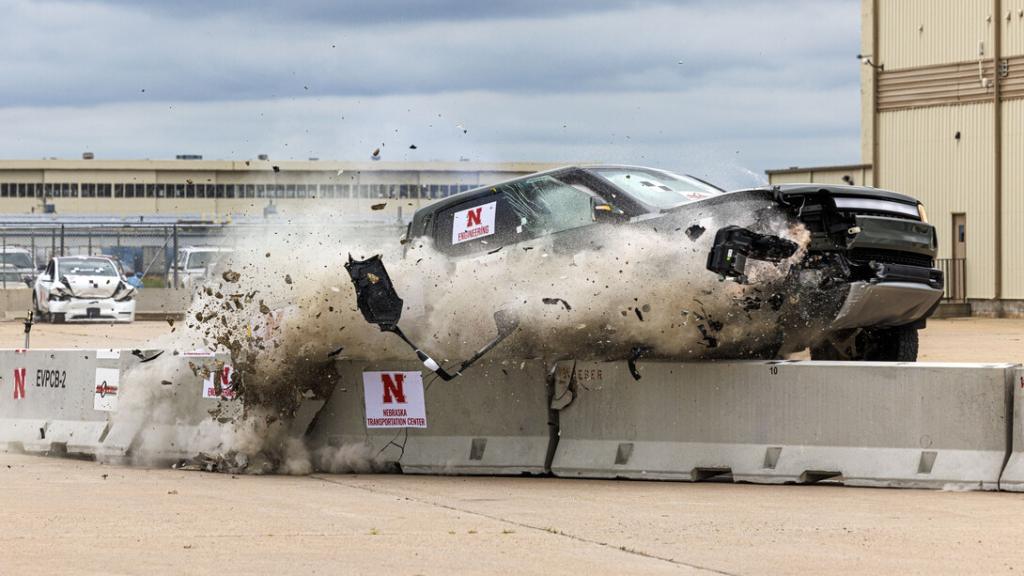
The Midwest Roadside Safety Facility at the University of Nebraska–Lincoln has conducted full-scale tests involving EVs and roadside hardware since September 2023. A peer-reviewed study, first published online in 2025 and later included in Transportation Research Record, summarizes four tests using Tesla Model 3 sedans and Rivian R1T pickups. The hardware included a steel guardrail system, a concrete bridge parapet, and a portable F-shape concrete barrier. The university’s test report and the peer-reviewed study describe the test scope and results.
The study reports that two tests on the Midwest Guardrail System did not meet the applicable safety requirements: one vehicle passed beneath the guardrail, while another ruptured it. In a concrete parapet test, the Tesla Model 3 produced occupant-risk measures above acceptable limits. In the portable-barrier test, the system contained and redirected the Rivian R1T, but its performance was at the system’s functional limit. The university’s account also describes severe damage to the barrier and substantial movement of several segments.
What the tests do—and do not—show
These results apply to specific vehicles, roadside hardware, and test configurations. They do not establish that every EV is more dangerous or that all existing guardrails will fail. Vehicle crash assessments and roadside-hardware tests address different questions: the former examine how a vehicle protects its occupants in specified crashes; the latter evaluate whether a barrier contains or redirects an errant vehicle and how the complete system performs under defined conditions.
Battery electric vehicles can differ from conventional vehicles in curb weight, mass distribution, frame structure, and geometry. Crash speed, impact angle, vehicle attitude, and the barrier’s rails, posts, connections, terminals, foundation, and installation condition also matter. The findings therefore cannot be reduced to “EVs are heavier, so guardrails fail”; simply increasing steel thickness is not a universal solution.
How project teams should assess compatibility
China has published JTG B05-01—2013, the Safety Performance Evaluation Standard for Highway Guardrails, and JTG D81—2017, the Design Specifications for Highway Traffic Safety Facilities. The U.S. tests discussed here use the MASH framework; their findings do not replace design or acceptance decisions under Chinese standards. A useful question for further research is whether the test vehicles, mass distributions, and vehicle structures in existing evaluation programs sufficiently represent the vehicles now entering service. Local fleet and crash data, analysis, and additional full-scale tests are needed to assess that question.
Guardrails should be evaluated as complete tested or project-approved systems, not as isolated rails or posts. Project teams should confirm the applicable standard, target performance level, test configuration, system drawings, post and connection details, terminals and transitions, foundation conditions, and installation requirements. Before replacing components or changing a configuration, the project designer and road authority should confirm that the change is acceptable.
What this means for guardrail suppliers
For suppliers, the task goes beyond providing steel, coating, and dimensional data. They should identify the system configuration to which a supplied product belongs, provide the supporting test or inspection evidence, state applicable installation conditions, and clarify the technical assistance available. Without supporting evidence, an individual component should not be represented as independently achieving a barrier performance level or as suitable for every EV and road environment.
The tests do not provide one guardrail solution for every vehicle. They highlight the need to keep vehicle characteristics and roadside-system test conditions aligned, and to make project decisions based on applicable standards, complete-system evidence, and actual site conditions.
Sources
- University of Nebraska–Lincoln: EV roadside crash-test report
- Peer-reviewed study: Evaluation of the Compatibility of Battery Electric Vehicles With Roadside Hardware
- China Ministry of Transport: JTG B05-01—2013 announcement
- China Ministry of Transport: JTG D81—2017 announcement
Editorial note: This article is an industry news report and technical commentary prepared by China Guardrail from public sources. It is not a crash-test report, engineering design document, or official translation of a standard. U.S. research does not determine design requirements for projects in China; projects should follow applicable local standards, approved designs, and complete guardrail-system configurations.
For a project-specific guardrail review, contact China Guardrail with the applicable standard, system drawings, and site requirements.