China Guardrail Factory
June 13, 2026
Q235 vs Q345 (Now Officially Q355) Steel
June 15, 2026China Guardrail Factory
June 13, 2026Q235 vs Q345 (Now Officially Q355) Steel
June 15, 2026Which One Does Your Project Need?
Standards Referenced: GB/T 31439.1-2015 · JTG D81-2017 · EN 1317 (EN 1317 series)-2:2010 · ISO 1461:2009
1,What’s the Difference?
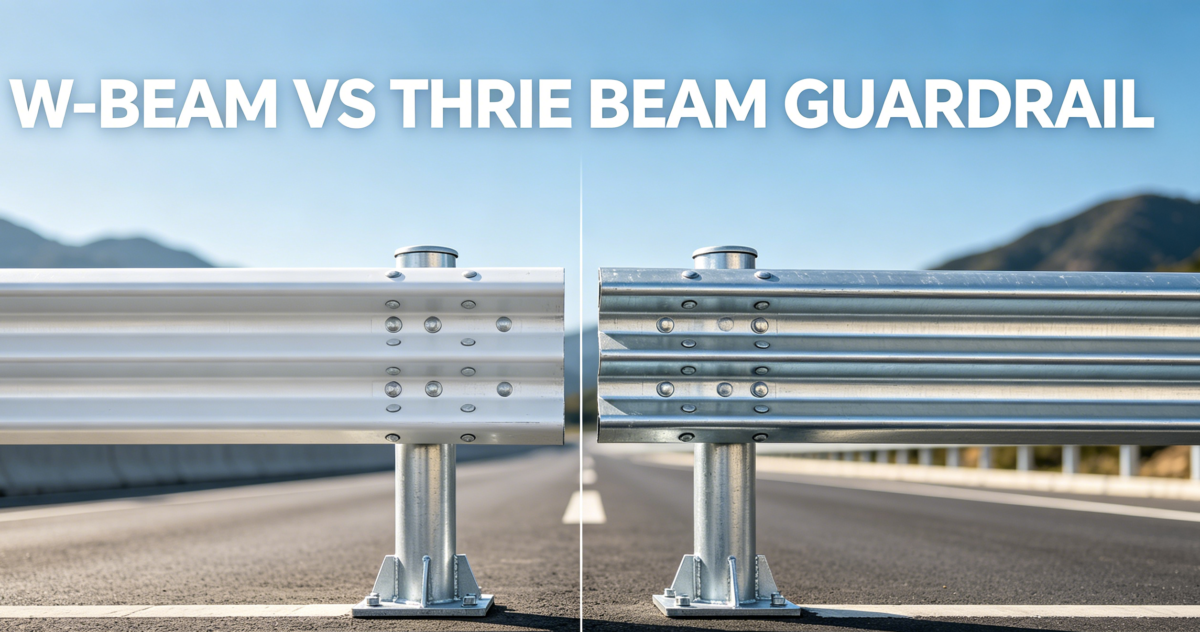
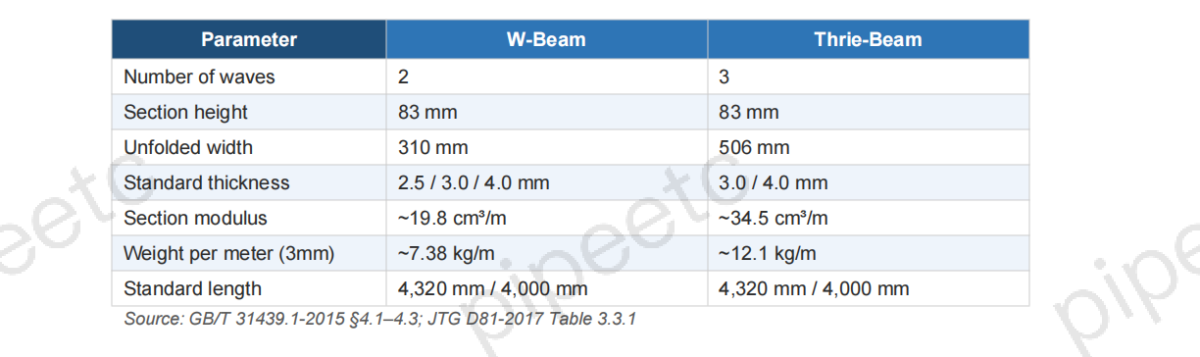
The most common steel guardrail you’ll see along highways gets its shape from a pressed corrugation that looks like a wave. A W-beam has two waves, a Thrie-beam has three. It sounds like a minor difference — but the performance gap is significant.
A W-beam unfolds to a width of 310 mm, while a Thrie-beam unfolds to 506 mm. A wider cross-section means a larger section modulus — in practical terms, when a vehicle strikes it, the Thrie-beam deflects less and pushes back with greater force, keeping the vehicle on the road.
2,How Much More Protection Do You Get?
This is the key question for selection. The Chinese standard classifies guardrails into four levels — A, SB, SA, and SS — while the European standard EN 1317-2 uses N2, H1, H2, and H4b. In both systems, higher letters and numbers mean the barrier can stop heavier vehicles at higher speeds.


Bottom line: W-beam is sufficient for ordinary roads. For expressways, bridges, mountain corridors, and heavy-load routes, Thrie-beam is the correct choice.
3,Which Sections Need Which Type?
The real challenge for buyers usually isn’t deciding which barrier is “better” — it’s figuring out which one fits a specific project.
Where W-Beam Is the Right Choice
· Rural highways and secondary roads with a design speed below 80 km/h
· Sections with adequate roadside clear zone (≥10 m), giving vehicles sufficient buffer space
· Infrastructure projects with strict budget constraints
Reference: JTG D81-2017 §3.2; GB/T 31439.1-2015 §6.2
Where Thrie-Beam Is the Right Choice
- Expressways with a design speed of 100 km/h or higher
- Bridges, elevated roads, and tunnel portals (mandatory under JTG D81-2017 §5.1
- Mountain roads, steep grades, sharp curves, and other high-risk accident sections
- Median barriers
- Freight corridors with a high proportion of heavy trucks
Reference: JTG D81-2017 §3.2–3.3; GB/T 31439.1-2015 §6.2
Special Sections: Combined W-Beam + Thrie-Beam Configurations
On certain high-risk sections, a single barrier type isn’t enough to meet safety requirements. In these cases, engineers specify a layered configuration — adding a W-beam rail alongside a Thrie-beam, on its inner or outer face, to create a dual-protection system. Common applications include:
- Bridge transition zones — where roadside guardrail transitions into bridge parapet, a sudden change in stiffness can cause a vehicle to rebound back into traffic after impact. A layered configuration steps up stiffness gradually, smoothing the transition and reducing the risk of secondary collisions.
- Runaway vehicle ramps on long downgrades — impact energy at these locations is extremely high, and a single layer cannot reliably control deflection. A dual-layer setup significantly increases energy-absorption capacity.
Tunnel portals — with limited space and effectively zero clear zone, the consequences of a vehicle losing control are severe. A combined barrier can raise containment to SS / H4b, meeting the highest protection requirements.
Narrow median sections on expressways — where opposing-traffic risk is highest, dual-layer configurations have already been mandated in some provinces.
Reference: JTG D81-2017 §5.2; GB/T 31439.1-2015 §6.3; EN 1317-2:2010 H4b configuration requirements
4. How the Costs Compare
A common assumption is that Thrie-beam costs more per ton because it’s a “premium” product. In fact, the per-ton steel price is identical — the cost difference comes entirely from weight per meter.
Using a reference steel price of RMB 5,500 / ton:

That additional ~RMB 26,000 per kilometer in material cost buys an upgrade in containment level from SB to SA, compliance for bridge and mountain-road sections, and reduced exposure to secondary accident losses. For high-risk sections, this is typically money well spent.
The figures above reflect guardrail panel material cost only, and do not include posts, bolts, blockouts, or installation. Installation costs vary significantly by country due to differences in site conditions and labor rates. If you’re evaluating suppliers for an upcoming project, it’s worth asking any highway guardrail manufacturer a few key questions: which containment levels they can certify, and what surface treatments they offer. Manufacturers based in China — particularly in Shandong, a major production hub — often have the capacity to produce both W-beam and Thrie-beam guardrail, which can simplify sourcing if a project requires both. Feel free to message us directly for a project-specific quote.
5. References
[1] GB/T 31439.1-2015. Highway Guardrails — Part 1: W-Beam Steel Guardrail. Standardization Administration of China, 2015.
[2] GB/T 31439.2-2015. Highway Guardrails — Part 2: Thrie-Beam Steel Guardrail. Standardization Administration of China, 2015.
[3] JTG D81-2017. Specifications for Design of Highway Safety Facilities. Ministry of Transport of the People’s Republic of China, 2017.
[4] EN 1317-2:2010. Road Restraint Systems — Part 2: Performance Classes and Test Methods for Safety Barriers including Vehicle Parapets. CEN, Brussels, 2010.
[5] ISO 1461:2009. Hot Dip Galvanized Coatings on Fabricated Iron and Steel Articles — Specifications and Test Methods. ISO, Geneva, 2009.
[6] Ray, M.H., Engstrand, K., Weir, J.A. (2001). Improvements to the Thrie-Beam Guardrail. Transportation Research Record 1743, Transportation Research Board, Washington D.C.
[7] Research Institute of Highway, Ministry of Transport (China). Study on the Impact Performance of W-Beam and Thrie-Beam Guardrails. China Communications Press, Beijing, 2019.
This document is intended for general reference. Please verify against the latest editions of applicable standards before use in design.
pipeetc: June 2026
Standards and Sources Referenced
The specifications and requirements discussed in this article are drawn from the following published standards and official guidance:
- AASHTO M180 — Standard Specification for Corrugated Sheet Steel Beams for Highway Guardrail. https://store.transportation.org/Item/PublicationDetail?ID=4140
- CEN/CENELEC — European standards body responsible for the EN 1317 series. https://www.cencenelec.eu/
- GB/T 31439 national standard lookup — Official Chinese national standards database entry for GB/T 31439. https://openstd.samr.gov.cn/bzgk/std/std_list?p.p1=0&p.p90=circulation_date&p.p91=desc&p.p2=31439
- EN standards catalogue (iTeh) — Public catalogue of published CEN standards including EN 1317. https://standards.iteh.ai/catalog/standards/cen/